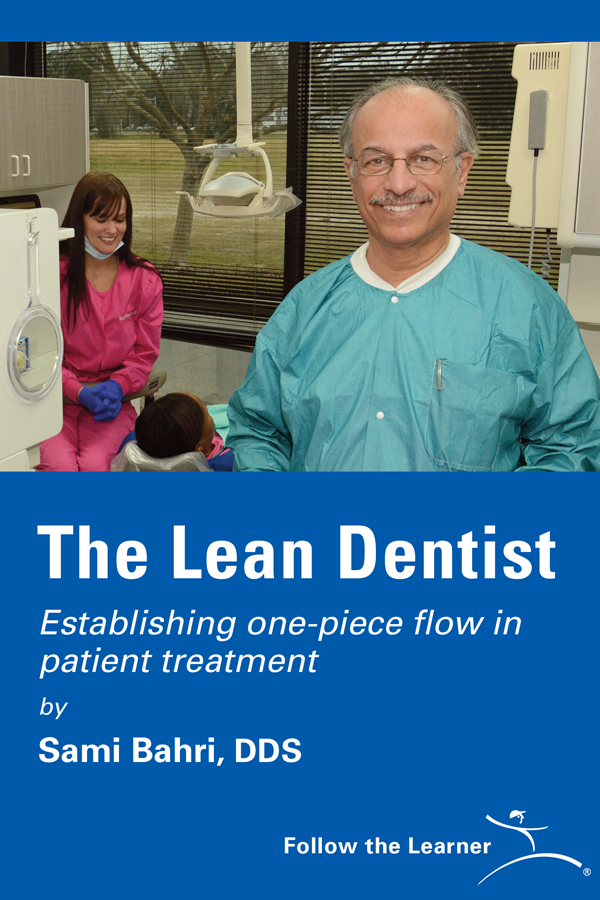
Shingo Research and Professional Publication Award recipient
What does it really mean to be a “learning organization”? What does it take to get the people in a nonmanufacturing environment to think of work in terms of flow? How do you build a culture based on lean principles and lead that culture as it continuously evolves?
In his book, Follow the Learner: The Role of a Leader in Creating a Lean Culture, Dr. Sami Bahri describes how he and the staff in his practice tackled each of these questions. The book describes how their organization, the Bahri Dental Group, transformed their work and their thinking from a traditional batch-and-queue approach to one focused directly on the needs of the patient, not on the needs of the practitioners.
Dr. Bahri discusses what inspired him to try lean methods, what results he has seen, and who can benefit from the book. (Note: To view the above clip, your company must allow streaming video.)
The book is organized into three sections–Creating the Practice, Leading the Transformation, and Discovering the Principles of Lean Leadership–that describe a personal and professional journey in terms that anyone, at any level, can learn from. It explains the technical changes that they made in the way that they scheduled and treated patients, as well as the understanding of the human interactions needed to make this new model succeed. Along the way, it demonstrates the universal application of lean concepts and methods in an environment with which we are all familiar, but is a long way from the traditional manufacturing roots of the Toyota Production System.
Dr. Bahri has created an honest and straightforward look at organizational transformation. He describes the experiments that led to rapid improvement and dramatic change, as well as the lessons he learned that changed his own definition of what it meant to be a leader. And he has created a leadership model of continuous improvement that lean thinkers and leaders everywhere can understand and relate to.
An interview with Dr. Sami Bahri, author of Follow the Learner: The Role of a Leader in Creating a Lean Culture
View the interview, or download a pdf of the transcript, or read the entire transcript below.
Dr. Bahri discusses what inspired him to try lean methods, what results he has seen, and who can benefit from the book. (Note: To view the clip, your company must allow streaming video.)
Q: Why did you want to find a better way to run a dental office?
A: I wanted to make dental care accessible to as many people as possible.
Actually, I was somewhat inspired by the idea of Henry Ford wanting to make the car available to everyone. I thought if he could make something this complicated popular and sell it everywhere, I should do something about dentistry. I started researching it a little bit, until we found a way actually, applying lean management to it.
Q: What business problems were you trying to overcome when you launched your lean conversion?
A: We had practical problems. We had long waiting times (that’s for the patients) – long waiting times in the waiting room, long waiting times in the chair before I got to them and treated them. We had frustrations with employees.
But there was a bigger problem. You see, in dentistry, we are used to learning everything about a problem or a theory. Let’s take gum disease for instance, we normally learn all the theories about gum disease and then decide which one works better for the patient. In management, when I started running my practice, I didn’t have that feeling. I didn’t have the feeling that I could decide between different choices, what is better. So I felt I needed to go and learn whatever is out there, so I would know cause and effect:
If I have a problem, what should I do to fix the problem? If something works well for me, why did it work? If something didn’t work, why didn’t it work, and how to fix it?
So we started on that long journey until we got the results we got.
Q: What made you think that the lean principles developed at Toyota could work for your practice?
A: Actually, at the beginning, I did not know whether the lean principles developed at Toyota could be the answer. I was trying everything, everything I could get my hands on, I tried to see what would give me better results. I just knew I wanted the best results for my patients. So whether it’s TQM, whether it’s a book talking about psychology, whether it’s a book talking about sales … I was trying everything.
Then in 2005, we had a big breakthrough while applying lean principles. And the results are really what convinced me that lean would work in a dental practice. So I would say, to answer your question, what convinced me are the results that I get from lean.
Q: Is your practice different today because of lean?
A: The practice is different today in that, before lean, I used to focus on my time as a provider. We used to think of quality of course, but we also used to think of productivity as a different entity. So I would think that if I had patients in the chairs waiting for me, my assistants would prepare those patients, and obviously they are waiting again, then I would go from one patient to the other and be productive. I would look at my bottom line at the end of the day and see if I produced or did not produce.
Today it is totally different. Today we look at the patient’s time and we try to flow the treatment so that patient is being treated all the time. So the focus, instead of being on my time, is on your time as a patient.
And, as happens with lean, everybody wins. Today I am much more efficient and much more productive by focusing on the patient’s time than by focusing on my time as a provider.
Q: How has your lean transformation benefitted your patients?
A: The patient benefits in different aspects.
The main one is that they can control their time – their time becomes predictable. Today if we tell you that your appointment for your cleaning is at twelve o’clock, for instance, you know that we are going to take you at twelve o’clock. If we tell you it’s 30 minutes, you know that in 30 minutes you will be out of the office, so you can really fit it in your schedule. Before lean, we would say twelve o’clock and maybe take you into the room at one-thirty, and then you would get done at two-thirty, so your whole afternoon was gone. Now treatment is predictable – you can fit it in your schedule, and you can really benefit from that.
Other aspects would be that your mouth will become healthy much faster. If we look at our statistics, before we started lean, to take a mouth with decay and gum disease and make it healthy, it used to take us something like 270 days including the wait between the appointments. So if you think about lead time as germs working on the teeth, germs working on the gums, now we eliminate that in 10 days versus 270 days (and sometimes years if the patient couldn’t come back). I think it’s a major benefit.
Q: How has your lean transformation affected your bottom line?
A: Being very specific about the numbers: in 2005 is really when the transformation happened. We had taken a loan on the office, and in the seven years up to 2005 we had paid off half of the loan. In 2005 we felt comfortable enough to pay the rest of the loan in one payment, one chunk.
There’s another aspect to it. You see, we take PPOs, we have contracts with insurance companies that reduce our fees. Before lean it was a struggle to make ends meet because we were not productive enough. Today, accepting those insurances with lower fees, we feel very comfortable with our productivity
Q: Why did you write your book Follow the Learner?
A: I wrote Follow the Learner because I feel we have been successful, somewhat successful, at implementing lean in dentistry. And I wanted to share that experience with people – people who are hesitating, people who are a little bit afraid to try it. Lean can be applied to any business, I want them to know that. I want to share the steps that we went through with them, hoping that it could help some people just take the first steps, and hoping that they will improve on it so the system can help patients later on. I would hope many, many patients would benefit from our systems.
Q: Is the book just for dentists?
A: I don’t think so because I learned it from manufacturers. I read many books, many, many books, from manufacturing and translated it into dentistry. I think there is no difference between dentistry, between healthcare, between manufacturing, between office … I think it’s just a matter of understanding the concepts, of understanding the principles, and it would apply to everything. The book is not for dentists, it is for everyone.
Q: What do you hope readers will learn from your book?
A: I would hope that the readers would have the confidence to go and find a system for themselves. To learn that there is no ideal system, there is no system that has all the answers, and they have to experiment to find what works best for them. I would hope that they would say, “He’s done it, so so can I!” I would like everybody, when they are through with the book, to close it and go try something, right away.