
Shingo Research and Professional Publication Award recipient
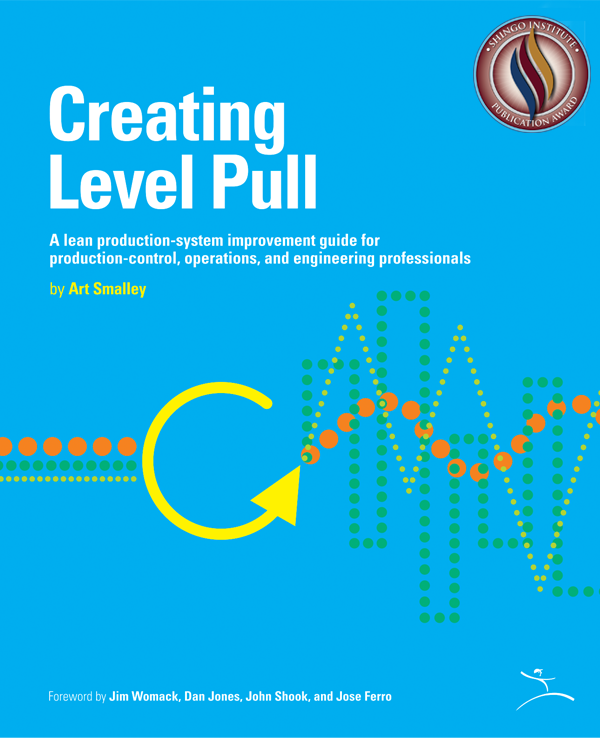
Creating Level Pull shows you how to advance a lean manufacturing transformation from a focus on isolated improvements to improving the entire plantwide production system by implementing a lean production control system.
“The workbook is unique because it is a step-by-step case study on how to implement a level, pull-based production control system,” says author Art Smalley. “This is a new step towards ‘system kaizen that is not yet well understood outside of Toyota.”
The lean efforts at most companies focus on “point kaizen” (e.g., reducing set up times, implementing 5S, etc.) that improves a small portion of the value stream running from raw materials to finished products. Or they focus on “flow kaizen” that improves the entire value stream for one product family. Creating Level Pull shows how companies can make the leap to “system kaizen” by introducing a lean production control system that ties together the flows of information and materials supporting every product family in a facility. With this system in place, each production activity requests precisely the materials it needs from the previous activity and demand from the customer is leveled to smooth production activities throughout the plant.
“A truly lean production-control system that rigorously controls production at every step and levels demand from the customer has proved a great challenge for most firms,” said Jim Womack, “but Art gives you all the knowledge needed to succeed.”
Like all LEI workbooks, Creating Level Pull is written in plain English and walks you through the implementation process using a clear question-and-answer format, supported by diagrams, value-stream maps, and all the key formulas. Using a realistic example facility, you see how to make the transition to a robust pull system. This involves answering a series of 12 critical questions including what items to hold in finished goods inventory and what items to make to order, how to buffer the system against instability, how to schedule batch processes, and how to level the production schedule. Careful attention to leveling (called heijunka) permits facilities to accommodate variations in demand with minimum inventories, capital costs, manpower, and production lead time. The questions for Creating Level Pull, which received a Shingo Research Prize in 2005, are:
Guarding Against Demand Surges and Production Shortfalls
- Which products should you hold in a finished-goods inventory, and which products should you produce only to a confirmed order?
- How much of each product should you hold in finished goods?
- How will you organize and control the finished-goods store?
- At what single point will you schedule the value stream?
- How will you level production at the pacemaker?
- How will you convey demand to the pacemaker and finished goods from the pacemaker?
Controlling Production Upstream
- How will you manage information and material flow upstream from the pacemaker?
- How will you size your markets and trigger withdrawal pull?
- How will you control batch processes upstream from the market?
Expanding the System
- How will you expand the level pull system across the facility?
- How will you sustain your level pull system?
- How will you improve your level pull system?


Reviews
There are no reviews yet.