Shingo Research and Professional Publication Award recipient
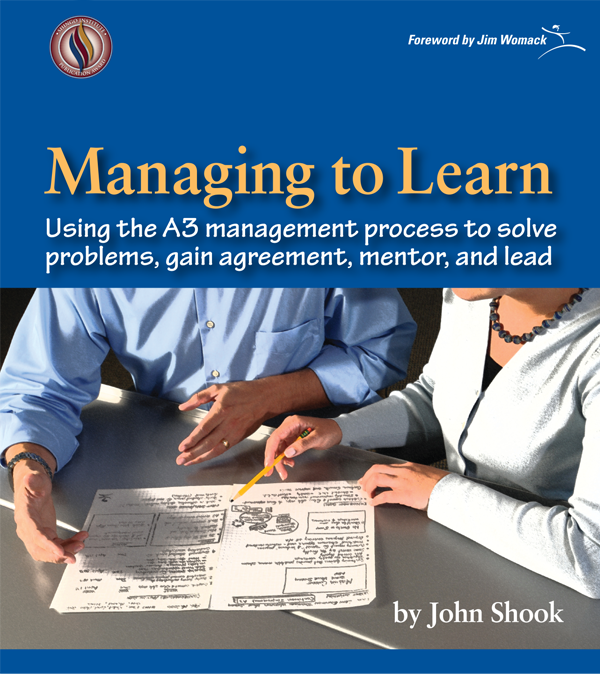
Managing to Learn by Toyota veteran John Shook, reveals the thinking underlying the vital A3 management process at the heart of lean management and lean leadership. Constructed as a dialogue between a manager and his boss, the book explains how “A3 thinking” helps managers and executives identify, frame, and then act on problems and challenges. Shook calls this approach, which is captured in the simple structure of an A3 report, “the key to Toyota’s entire system of developing talent and continually deepening its knowledge and capabilities.”
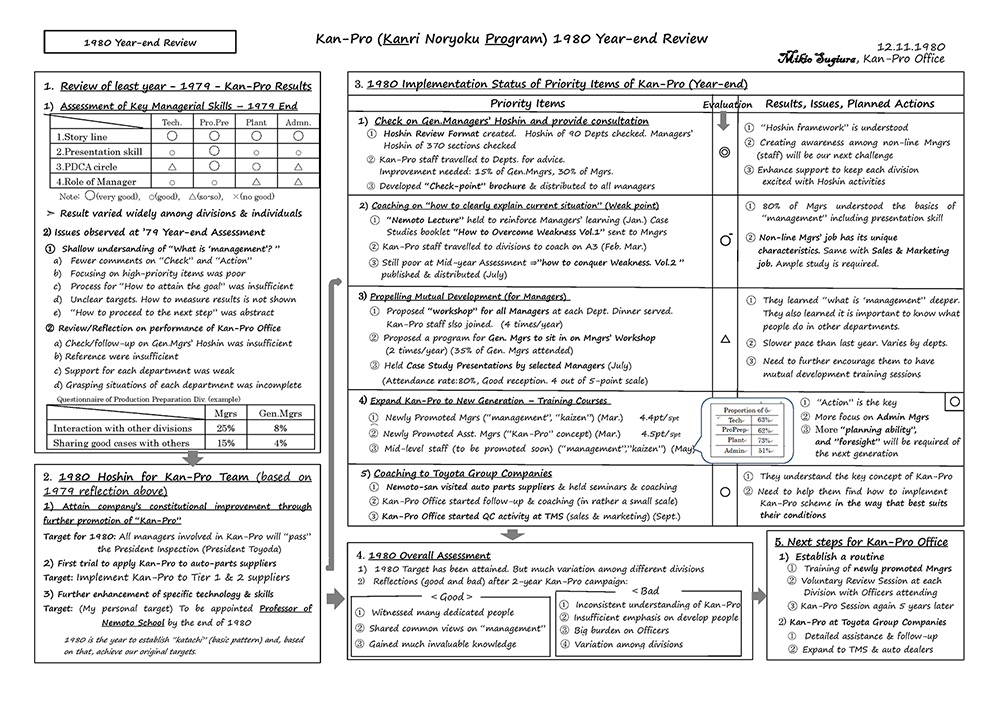
The A3 Report is a Toyota-pioneered practice of getting the problem, the analysis, the corrective actions, and the action plan down on a single sheet of large (A3) paper, often with the use of graphics. A3 paper is the international term for a large sheet of paper, roughly equivalent to the 11-by-17-inch U.S. sheet.
“The widespread adoption of the A3 process standardizes a methodology for innovating, planning, problem-solving, and building foundational structures for sharing a broader and deeper form of thinking that produces organizational learning deeply rooted in the work itself,” says Shook, who 10 years ago co-authored Learning to See, a groundbreaking LEI publication that taught readers how to map value streams to identify and eliminate waste. Learning to See has sold more than 173,000 copies and been translated into 12 languages.
Management expert James Womack, Ph.D., LEI founder and chairman, predicts Managing to Learn will have as deep an impact on the way lean companies manage people as Learning to See had on managing processes. “Readers will learn an underlying way of thinking that reframes all activities as learning activities at every level of the organization, whether it’s standardized work and kaizen at the individual level, system kaizen at the managerial level, or fundamental strategic decisions at the corporate level.”
A unique layout puts the thoughts of a lean manager struggling to apply the A3 process to a key project on one side of the page and the probing questions of the boss who is coaching him through the process on the other side. As a result, readers learn how to write a powerful A3—while learning why the technique is at the core of lean management and lean leadership.
Who Benefits
Executives and managers at all levels in the organization will benefit from the book. An A3 can be used wherever there is a need for people to work together to get clarity on a problem or proposal and then to create a set of realistic and effective countermeasures. A3s can be prepared by individuals, teams, or any leader and his or her report.
What is an A3?
The most basic definition of an A3 would be a PDCA storyboard or report, reflecting Toyota’s way of capturing the PDCA process on one sheet of paper. But the broader notion of an A3 process—the way of thinking represented in this format—captures the heart of lean management. In this context, an A3 report structures effective and efficient dialogue that fosters understanding followed by agreement. It’s a tool that engenders communication and dialogue in a manner that leads to good decisions, where the proposed countermeasures have a better chance of being effective because they are based on facts and data.
Are there different A3 types for different situations?
Companies that use A3 reports often think of them in three or four categories.
The most basic is problem solving. This one takes on a fairly mechanical problem that can be analyzed to find a definable root cause, and that has clear-cut measures of success. This type of report calls on the author and all the participants to practice the Five Whys and other problem-analysis tools.
The proposal A3, which is what the character Desi Porter uses in the book, looks to the future (ideal) condition as a way of identifying the ongoing and immediate problem that needs to be fixed. This type of A3 tends to have more complex problems with multiple causes. The countermeasures may cut across organizational boundaries. As a result, the means by which the A3 author/owner can gain agreement and alignment across the organization become critical. While defining and analyzing the problem are critical, the author must then use nemawashi and dialogue and other methods to adopt the countermeasures.
A third type is typically called the status review, and refers to the current status of a problem A3 or any issue with information that needs to be shared.
Finally, there is a planning A3, which typically appears in the hoshin kanri planning process. Because any proposal has a plan as part of it many people don’t see this as separate proposal. You don’t need to spend much time on root cause analysis because there is already basic agreement on the current state.
How, literally, should I create an A3? Should I use a pencil or pen? Should I use a computer? And if so, which program is best?
Before responding to this question directly, understand that simply learning to produce an A3 report is not the most important issue. Most individuals will find that it’s relatively easy to create one. The real challenge is how you read, and use, these documents. That’s perhaps the core message of Managing to Learn. And that’s why the book spends so much time showing how reports are used to facilitate dialogue, and how individuals playing specific roles at specific times bring different tools and understanding to the task at hand.
That said, like most experienced practitioners, I prefer to write A3 reports by hand. It’s amazing how your thinking will become more engaged in the process with the simple thought of putting pencil to paper.
However, this is the computer age and many individuals and companies find it easier to create, share, and even store their A3s electronically. While all of the most popular computer programs can be used, each exerts a specific influence that can produce drawbacks. Some people swear by the capabilities of Excel, but I find it too difficult to use, and believe that the final products look unfriendly. Microsoft Word, on the other hand, is the simplest program, yet doesn’t lend itself easily to graphics, leading to reports that are often text-heavy. When creating an A3 with a computer, I favor using PowerPoint.
Should I use a standard A3 format?
Some companies create standard templates and make them available on a shared electronic space. Articulating and sharing a standard way of thinking can be a very productive thing. However, beware. The good news about creating a template is that people will follow it. And the bad news is…that they will follow it. The key thing to keep in mind is that the paper and format are far less important than the learning journey.
In terms of sharing and storing A3s, I don’t believe that I can give you the best advice on this logistical matter. Companies do everything from physically walking a current report through the gemba, to making photocopies and distributing them, or creating electronic methods of intranets or wikis or other shared spaces. The point here is to produce the method that works best for you.
For readers who are looking for takeaways that help them at work, should they expect Managing to Learn to provide immediate “how-to” tips that boost performance, or more big-picture types of ideas? Is this a “tool” book or is it a “management” book?
The answer to that question is…yes. There’s a great dilemma here. It’s easy to say that this is both a tool and management book at the same time. I’ve chosen to present the material in a way that emphasizes the managerial aspect, primarily because up until now, most works of this nature don’t get beyond PDCA. But at the same time, without teaching the discipline of rigorous problem-solving, this becomes somewhat of a fairy tale without any teeth to it. I’m always concerned about giving the tool without the wrapping, but equally concerned about giving too much wrapping.
My goal with this book is to provide a complete and accurate description of A3 management, so that a serious reader can get insights into the holistic nature of this system, seeing how this tool can be a way for them to approach this from whatever level they happen to be at.
How does A3 management fit in with other problem-solving tools and methodologies?
To answer that, one needs to see that “problem-solving” tools are really both problem and analysis tools. Likewise, an A3 contains both a problem and analysis section. One of the distinctive qualities of the A3 is that it properly frames any problem, as a story within a business context, and encourages the use of any scientific tool of analysis.
How do A3s relate to value-stream maps, as well as other lean tools?
Either can spawn the other. That is to say, an A3 can lead to the value-stream map or the value-stream map can generate an A3 to solve a specific problem. The most important thing to keep in mind is that every lean tool exists to address one question, which is: what problem do you want to “solve”? No tools are used in isolation. They are themselves temporary countermeasures, ways to address the stated problem at hand.
Also, these tools become effective only when the company has a hoshin kanri process in place. That’s how you make it work. Every individual working at a company with a commonly understood system of policy deployment can launch an A3 very clearly. But it’s extremely challenging to bring A3 thinking into a traditional management structure without this process. Without clear lines of decision making and empowerment of associates, so individuals know when and how to initiate an improvement idea, people in the organization get very confused.
Can I change my company’s culture by using A3s?
Edgar Schein, one of the authorities on organizational behavior, advises, “Don’t start by trying to change your culture.” Changing values and beliefs is nearly impossible: what you can change is what you DO. I’ve found from experience that it is easier to act your way to a new way of lean thinking to think your way to a new way of lean acting.
Can't the A3 process become bureaucratic and take too long?
Of course it can! Don’t let it!
Do A3s lead to conflict?
Of course they do! Or, more accurately, they reveal organizational disconnects and conflicts that are already there.
- Can A3s be used to manage meetings?
A3s enable and encourage discussion (as noted in the book.) But they also direct or control discussion so one powerful practical use of A3s is to manage meetings. The specific elements of an A3, such as defining the problem, can help prepare an effective meeting by clarifying to everyone the precise purpose.
What are some common mistakes that people should be aware of avoiding?
Users of the process often become more concerned with getting the A3 “right” than with resolving the issue at hand. That is a typical problem introduced with an A3. Or they get so enamored with the process that they create a proliferation of A3s, all of which get written and shared and stored, but are not used to resolve problems or gain agreement.
Does everybody on a team need to be “fluent” in A3 for one person to author and start using one?
For everyone to become fluent someone must start using one.
Was it hard for you to learn A3 thinking?
Yes. Everything about this process was initially an alien concept to me. I expected a job description and clear set of responsibilities when I started working for Toyota; instead I was given an A3 and needed to learn my own duties, as well as the managerial system, through the nitty-gritty work of producing, revising, and continuing to produce new A3s. This was a long and cumbersome process, but it was only through actually writing and revising and constantly redoing this collaborative tool that I learned about A3 thinking.