
Lean Thinking and Practice
A five-step thought process proposed by Womack and Jones in 1996 to guide managers through a lean transformation. The five principles are:
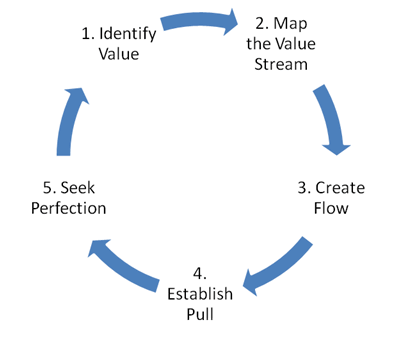
- Specify value from the standpoint of the end customer by product family.
- Identify all the steps in the value stream for each product family, eliminating whenever possible those steps that do not create value.
- Make the value-creating steps occur in tight sequence so the product will flow smoothly toward the customer.
- As flow is introduced, let customers pull value from the next upstream activity.
- As value is specified, value streams are identified, wasted steps are removed, and flow and pull are introduced, repeat this process again and continue it until a state of perfection is reached in which perfect value is created with no waste.
(Adapted from Womack and Jones 1996, p. 10.)

In 2007, Womack and Jones simplified the five steps to these—Purpose, Process, People:
Purpose: The primary purpose of any organization and first step in any lean thought process is to correctly specify the value that the customer seeks in order to cost-effectively solve the customer’s problems so the organization can prosper.
Process: Once purpose is clarified, focus on the process (value stream) used to achieve this objective. This is generally the combined result of three processes: product and process development, fulfillment from order to delivery, and support of the product and the customer through the product’s useful life. These primary processes are made possible by many secondary, support processes inside the organization and upstream.
The ideal process is one in which every step (action) is:
- Valuable: Meaning that the customer is willing to pay for the step because it creates value and would object if the step was deleted.
- Capable: Producing a good result every time.
- Available: Being able to operate whenever needed.
- Adequate: Having the capacity to keep production in continuous flow.
- Flexible: Permitting a range of products within a product family to move through a process without batching and delays.
In addition, in the ideal process the steps are linked by:
- Flow: So the good or service proceeds immediately from one step to the next without stopping.
- Pull: So the next downstream step obtains just what it needs from the next upstream step when continuous flow is not possible.
- Leveling: From some pacemaker point to smooth the operation of the process while still addressing the needs of the customer.
People: After identifying the primary and support processes needed to create value for the customer, make someone responsible for each value stream. This value-stream manager must engage and align the efforts of everyone touching each value stream to move it steadily toward the customer while elevating performance from its current state to an ever-better future state. Doing this requires:
- A master plan for the enterprise, often called strategy deployment.
- Frequent improvement cycles for each process, often performed with A3 analysis embodying value-stream maps.
- Standard work with standard management for every step in each process.