Here’s a common story I hear from leaders I coach.
My company knows we need better cross-functional teams to be more effective in product development. We’ve always struggled to get people assigned upfront from various departments leading to delayed or slow starts on projects, taking shortcuts on projects, and a panicked rush to complete them. In the last couple of years senior leaders have heard our concerns and stepped up to staff up most of our cross-functional teams upfront, and, as a project lead, I do see that more tasks are getting done on-time… Still, our project lead times haven’t improved and launches are still rocky at best. The last couple of products we launched were just “meh” and my project is on track for the same! I’ve tried several team building exercises and co-locating team members where possible, yet it feels like everyone is doing their job and the team is still not gelling.
Sound familiar?
If we want to create products that are truly valued by customers and create profitable value streams for the business, we must create a cross-functional team structure. The good news? This structure brings the multiple talents and experiences of the people together. The bad news? It doesn’t guarantee performance.
As I’ve observed teams over the years, it’s become clear to me what needs to be in place for them to perform well. The characteristics and behaviors that make teams effective include clear purpose, transparency and trust, integrative leadership, and adaptability.
Clear Purpose: Focus on product value versus functional goals
Many teams will say, “We already have project goals,” yet when looking at their scorecard, they typically have goals structured by function. When looking at cost, goals are broken down by material cost (purchasing), labor cost (manufacturing), capital cost (manufacturing), and project cost (engineering). While these costs are incurred by the respective functions, it often drives team members into silo optimization. Having common, aligned goals for the product (rather than the function) clearly guides the team on what “success” looks like. This is why we always say, “Product development is a team sport.”
A project leader for a very successful consumer product once told me, “If people don’t know what success looks like, they can’t effectively and efficiently work through tradeoffs and make good decisions in a timely manner.” Rather than create functional goals, this leader, for example, set up total cost product goals for each module of the product. Each module team then had the responsibility (and the latitude) to make decisions to optimize the overall cost of the product and its associated value stream.
Creating a Concept Paper is another proven way to align and enroll project teams as well as the overall organization on the value-driven purpose for a product. This prompts team members to ask questions and challenge assumptions about their customers’ needs and what they truly value. As people work through these tradeoffs, the team engages key stakeholders to get their input and clarify and align internal goals with external customer needs.
Good communication is more than simply frequent communication; it’s purposeful communication.
How will you know if your team is effective at sticking to its purpose? Watch how they react when unanticipated challenges arise, not when things go according to plan. Do people retreat to their functional silos for cover? Try to pass items off to another teammate? Or are they taking collective ownership to address the challenge together?
Transparency and Trust: Collaborative versus Transactional
Many teams stress the importance of having clear roles and responsibilities. In weak cross-functional teams, people may attend meetings but remain primarily accountable to their home departments. On the surface this drives role clarity, individual ownership, and accountability for tasks. Clarity can prevent duplication of effort, delays, and friction within a team. However, teams with this mindset frequently find themselves in a transactional mode of doing their duty to provide information and deliverables per the plan yet missing context, clarity, or quality. Good communication is more than simply frequent communication; it’s purposeful communication. People should know what information is relevant, when it must be shared, and where it can be found.
High-performing teams understand how each team member’s work fits together which allows them to work with stable yet incomplete information. Getting started on the work earlier allows teams to detect risks and address tradeoffs upfront (i.e. pulling collaboration forward). Strong communication includes active listening. People must be willing to explain their own constraints while trusting the expertise of others. When these perspectives are integrated early on, teams can avoid costly handoffs, rework, and frustration later. Making the work visual and having an operating system such as an obeya (big room) creates an environment of trust by providing transparency, a steady cadence to communicate issues, and a space to get help to work through issues collaboratively.
This resulted in the team delivering the project an incredible 45% faster with fewer late changes and a much smoother launch.
For example, I recall working with one project team that had been challenged to launch their product in record time, helping them to think through how they each deliver their work to each other. In the past, their plans had been essentially driven by passing along “completed” deliverables. This led to handoffs and reviews happening later in the timeline and issues surfacing late. (Think of building large batches in the factory and finding a defect later). The team started by creating a visual schedule together in the obeya. Each person asked themselves, “What is the smallest increment of information that is stable, albeit incomplete, that I need to start my work? And where I can provide that input as early as possible?” Every week, team members would stand around the visual schedule to see if they could “give” or “get” new learnings to collaborate as early as possible. This resulted in the team delivering the project an incredible 45% faster with fewer late changes and a much smoother launch.
Integrative Leadership: Bringing people together to create great products versus managing tasks
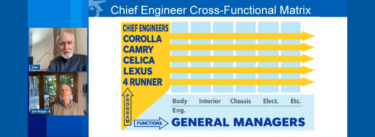
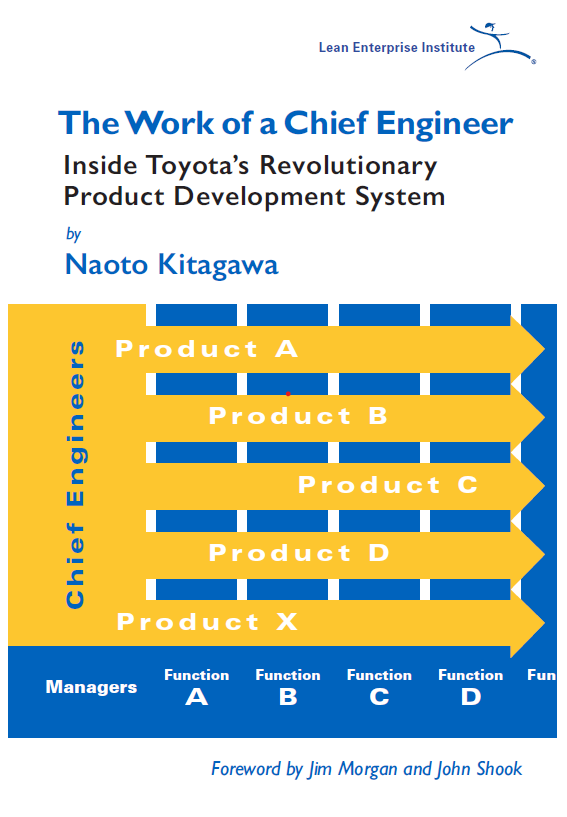
Effective product leaders have experience and credibility within their organization. They have a knowledge and passion for their product and keep their cross-functional team focused on the purpose of creating great products and solving the problems that block them from achieving shared goals. They know how to bring the right people together at the right time to adjudicate tradeoffs, have constructive debates, and manage the conflicts that ensue. They also do the critical work of removing barriers and protect the team from excessive bureaucracy and unnecessary work. (Several more mature lean organizations have built up a Chief Engineer System to develop people to fulfill this crucial role).
Here’s an example of what this looks like in practice. A program manager for a consumer product company I had the privilege of working with shared that their team was facing a lot of competitive pressures to get a new product out to the market. Early in the project, the team raced through the study (concept) phase to meet deadlines and some of the team had gravitated towards a particular solution. The styling group thought it was aesthetically great, product engineers thought it was feasible but a bit risky on durability, and manufacturing had concerns about the ability to produce it at scale for the targeted quality level and cost. The program manager brought the team together to surface all the risks versus the value it would bring to the customer and the company.
In this process, it became clear that several team members had clear reservations on the design direction but were fixating on meeting the deadline to freeze the concept. This leader challenged the team to slow down and take time to study other options to be sure rather than just settling in on the current concept. The team pushed back saying they didn’t have time to do additional exploration and meet the concept freeze deadline. The program manager replied, “Our primary job is to get the right product. Let me worry about the timeline.” The program manager then advocated to the stakeholders that the team needed to take an additional four weeks to get the right product. In the end, the team ultimately gained that time and effort back later in the project and met the targeted launch date.
The lesson here? Leaders must create an environment of psychological safety. As Amy Edmondson reminds us in The Fearless Organization, psychological safety means that team members feel comfortable to ask questions, raise concerns, admit mistakes, and challenge assumptions without fear of embarrassment or retribution. Over time, this allows people to identify problems earlier, learn faster, and ultimately drive more innovative solutions.
Leaders of various functions must also contribute resources and/or act as key stakeholders of the outcome. They should:
- Develop peoples’ skills so that they can be strong contributors to the cross-functional team
- Entrust and give people authority to make the right decisions for the project (even if these decisions appear counter to their own department)
- Provide the team with help in a timely manner when an issue is escalated
Adaptability: Recognizing when change is needed versus rationalizing the current direction
Finally, high-performing cross-functional teams are adaptable. The problems people try to address are often ambiguous, and plans often change as new information emerges. Adaptable teams continuously learn from what is happening, review progress honestly, and adjust their approach when evidence suggests a better path.
What does this look like? One project team I worked with was on a tight delivery schedule promised to customers. The team had been doing some great work upfront and all the simulations were pointing to a robust solution. However, during the physical testing phase they encountered an unanticipated failure that was critical to the product’s performance. The team worked through several potential options and ultimately determined that the best solution would require a redesign of one of the major subsystems as it was “the right thing to do.” Then one team member surfaced the issue that the tooling supplier would now be 4–6 weeks per the timeline with the new design. The team instinctively rallied around their visual schedule and started moving sticky notes around to see how they could get the project back on track.
The program lead commented that in the past, this team would have likely gone with a short-cut solution that either reduced value or added cost to make the deadline. Or, people would have come to him to deal with the added 4-6 week schedule slip. But through working together, with common goals in the obeya space, the team was able to face issues head on and take shared ownership of the program outcome.
In summary, high-performing, cross-functional teams are successful when the team’s diverse expertise is organized around a clear shared purpose in a transparent, collaborative environment led by a capable integrative leader. Teams remain adaptable to changing conditions and commit to working together to navigate the challenges that confront them.
In a world where organizations must quickly innovate and solve complex problems that cut across the enterprise, having a truly effective cross-functional team is necessary achieve great results. The leader’s job is to create such teams.
Do you have a cross-functional team starting a new project? Would you like to learn how to use lean product and process development principles and practices to improve their performance?
Join The Lean Enterprise Institute for upcoming Designing the Future Using Lean Product and Process Development interactive workshop. This workshop is best suited for executives, senior leaders, product leaders, and cross-functional teams starting new projects.
John Drogosz is a senior LPPD coach at the Lean Enterprise Institute. He has coached teams in various industries over the past 25+ years to embed Lean Principles and Practices in their organizations.
Designing the Future Using Lean Product and Process Development
Learn how to reduce time to market, improve quality, and drive innovation.