Lean Enterprise Institute Logo
  • Contact Us
  • Newsletter Signup
  • Cart (0)
  • Account
  • Search
Lean Enterprise Institute Logo
  • Explore Lean
        • What is Lean?
        • The Lean Transformation Framework
        • A Brief History of Lean
        • Lexicon Terms
        • Topics to explore
          • Operations
          • Lean Product and Process Development
          • Administration & Support
          • Problem-Solving
          • Coaching
          • Executive Leadership
          • Line Management
  • The Lean Post
        • Subscribe to see exclusive content
          • Subscribe
        • Featured posts
          Viwinco vs Switchgear. Five Same LTF questions, Five different answers.

          Same Questions, Different Answers: A Lean Transformation...

          The Answer to Organizational Complexity: Build in...

          • See all Posts
  • Events & Courses
        • 2027 Lean Summit
          March 16-17
        • Forms and Templates
        • Featured learning
          • Managing in Time with Daily Management

            January 15, 2027 | Coach-Led Online Course

          • The Lean Management Program

            February 05, 2027 | Coach-led Online Program

          • Lean Warehousing and Distribution Operations

            February 17, 2027 | CITY Home in Plant City, FL

          • Standardized Work: Foundations to Practice

            February 25, 2027 | Gilbarco Veeder-Root | Greensboro, NC

          • See all Events
  • Consulting & Training for Organizations​
        • Interested in exploring a partnership with us?
          • Schedule a Call
        • Getting Started with LEI
        • Enterprise Workshops and Training
        • Leadership Development
        • Lean Product and Process Development
        • Lean Enterprise Transformation​
        • Case Studies
  • LeanAI
  • Store
        • Book Ordering Information
        • Shopping Cart
        • Featured books

          The Work of a Chief Engineer: Inside Toyota’s Revolutionary Product Development System

          Daily Management to Execute Strategy: Solving problems and developing people every day

          • See all Books
  • About Us
        • Our people
          • Senior Advisors and Staff
          • Faculty
          • Board of Directors
        • Contact Us
        • Lean Global Network
        • Press Releases
        • In the News
        • Careers
        • About us

The Lean Post / Articles / Toyota Veteran Naoto Kitagawa’s 17 Principles for Chief Engineers 

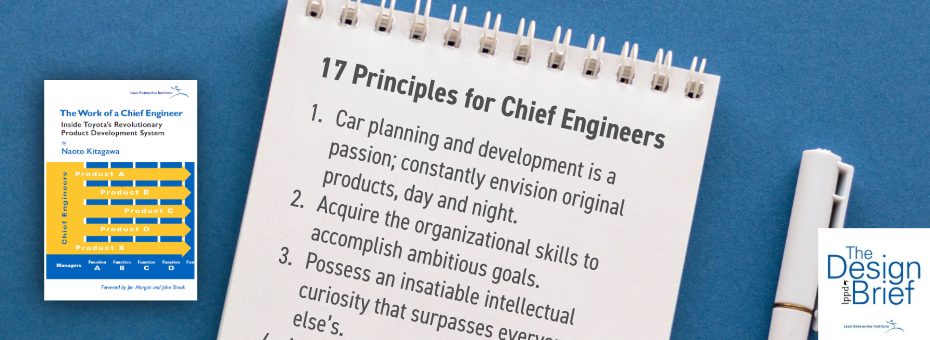
17 Principles for Chief Engineers 

Product & Process Development

Toyota Veteran Naoto Kitagawa’s 17 Principles for Chief Engineers 

By Lex Schroeder

October 12, 2026

Former Toyota chief engineer Naoto Kitagawa shares his 17 principles for leading product development, with reflections from John Shook and Jim Morgan.

FacebookTweetLinkedInPrintComment

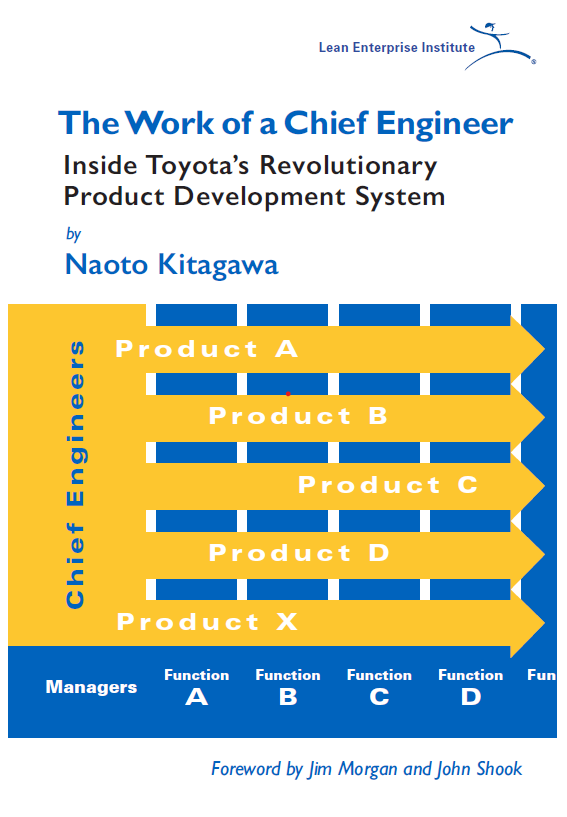
In October, the Lean Enterprise Institute published The Work of a Chief Engineer: Inside Toyota’s Revolutionary Product Development System by Naoto Kitagawa. The author, a former chief engineer at Toyota, takes you inside Toyota’s acclaimed product development system, sharing proven principles and lessons that any company can adapt to reliably create profitable, high-quality products that customers will actually want to buy. During his time at the company, Kitagawa was the Chief Engineer for the Camry, bB, Avalon, Solara, and many more vehicles. 

At Toyota, the chief engineer (CE) is the program manager with total responsibility for the development of a product line. In this excerpt from the book below, Kitagawa’s “17 Principles for CEs” we learn what this unique role requires and why it makes such a difference. Read on for reflections from John Shook and Jim Morgan that help us understand what these principles look like in practice. 

17 Principles for CEs 

What qualities and qualifications are essential for a CE—the linchpin of product development? What mindset is required? [I developed the 17 principles] based on my experience and three core attitudes that I prioritized in every project I handled. The three attitudes are: 

  • Curiosity 
  • Empathy
  • Imagination 

I made it a point to cultivate robust curiosity, empathize with customers and the global environment, and visualize concretely what kind of car—including concept, vehicle packaging (like a house layout), design, and performance, etc.—would impress our target customers. Working with these three attitudes, I developed the following 17 principles required of a CE: 

  1. Car planning and development is a passion; constantly envision original products, day and night. 
  2. Acquire the organizational skills to accomplish ambitious goals.  
  3. Possess an insatiable intellectual curiosity that surpasses everyone else’s.  
  4. Master the ability to clearly express your thoughts and ideas. 
  5. Build a broad network of people who will help in times of need. 
  6. Consider yourself the personnel and administrative manager of your group. 
  7. Check drawings with single-minded diligence and thoroughness. 
  8. Diligently and thoroughly cultivate the field of cost management to achieve cost targets. 
  9. Don’t leave how to sell your products solely to sales; devise your own promotional and sales strategies. 
  10. Skillfully utilize experts for knowledge you lack, but never neglect your own studies. 
  11. Lead by example—genchi genbutsu (go to the source to see the actual situation yourself).  
  12. Practice interactive development with users at the earliest stage; when in doubt, observe customers. 
  13. Consider development schedule delays the greatest shame. 
  14. Diligently nurture young talent and the next generation of CEs; correct them sternly but skillfully on occasion. 
  15. Be the most powerful salesperson for new market development; actively venture into new markets. 
  16. Be grateful to everyone who supports you. 
  17. Cultivate the physical and mental stamina to fight 24 hours a day. 

John Shook and Jim Morgan, who wrote the book’s foreword, recently joined Tyson Heaton on a Lean Enterprise Institute webinar to discuss this unique role of Chief Engineer at Toyota. In a far-ranging conversation, they elaborate on Kitagawa’s 17 principles for Chief Engineer. 

  • Summarizing Kitagawa’s list, Morgan reminds listeners, “The functional leader’s job is to create exceptional engineers; the Chief Engineer’s job is to create exceptional products.” 
  • Explaining principle 2, Shook says: “[The CE has] a tremendous, vast responsibility with no authority… There’s a paradox there. American organizational theory tells you don’t do that… in this case, that situation is what the CE lives with all day every day… [The CE] has to lead by influence, by getting people on board, by stating a strong case, [starting with] a nice succinct A3.” 
  • Speaking to principles 9 and 15, Shook notes how many hats a Chief Engineer needs to wear: “If the Chief Engineer is successful, the product will be successful… if there’s a place where organizations trip up, it’s finding the person with the skills of the Chief Engineer. [This person must be] a technician and a businessperson and an organizational savant.” 
  • On principles 11 and 12, Morgan points to Kitagawa’s storytelling of how he worked to truly grasp the situation and keep his focus on the customer in his role as CE: “Kitagawa did what any good lean practitioner would do. He started out at the gemba. He went to see the customer. He went to understand personally what this customer valued, what the product had to be, how to create a compelling vision for the value that this vehicle could take, and then he fought for it all the way through the development process…” 
  • Reflecting on Kitagawa’s Camry story specifically (and principles 12 and 15), Morgan says: “It’s a classic Toyota approach to product… It’s not enough just to have marketing go hold focus groups and write up a brief and share it with the team… They really immerse themselves in the customer’s world to understand how they were using their cars, what they expected of their cars, and most importantly, where the current model was falling short.”  

At the end of the day, the Chief Engineer must understand what customers truly value and align the team around this vision. And, as Kitagawa says, they must do this without formal authority and with curiosity, empathy, and imagination. Morgan says it well: “One of the things that’s so important about the Chief Engineer role is the integration of all these disciplines and capabilities into a single product… [The CE] is the conductor who leads the orchestra and takes all of these various capabilities and integrates them into beautiful music.”

Learn more about lean product and process development at lean.org/LPPD
FacebookTweetLinkedInPrintComment

Related book

The Work of a Chief Engineer: Inside Toyota’s Revolutionary Product Development System

The Work of a Chief Engineer: Inside Toyota’s Revolutionary Product Development System

by Naoto Kitagawa

Written by:

Lex Schroeder

About Lex Schroeder

Lex Schroeder is a strategy and operations leader/writer breaking open new conversations about the future of work. A longtime editor in the systems thinking community, she has led strategic initiatives at The Lean Enterprise Institute and The Berkana Institute. In 2015, she served as Founding Editor and Co-Lead of The…

Read more about Lex Schroeder

Leave a Comment Cancel reply

Your email address will not be published. Required fields are marked *

Related

Design Brief | Reinventing Product Development: People First, Technology Second 

Product & Process Development

Design Brief | Reinventing Product Development: People First, Technology Second 

Article by James Morgan, PhD

The Answer to Organizational Complexity: Build in Lean Product and Process Capability

Product & Process Development

The Answer to Organizational Complexity: Build in Lean Product and Process Capability

Podcast by Lex Schroeder

Revisiting the Toyota Production System in the Age of AI Coding Agents 

Product & Process Development

Revisiting the Toyota Production System in the Age of AI Coding Agents 

Article by Remo H. Jansen

Related books

The Work of a Chief Engineer: Inside Toyota’s Revolutionary Product Development System

The Work of a Chief Engineer: Inside Toyota’s Revolutionary Product Development System

by Naoto Kitagawa

The Power of Process book cover

The Power of Process – A Story of Innovative Lean Process Development

by Eric Ethington and Matt Zayko

Related events

Online – On-Demand, Self-Paced

Lean Fundamentals Bundle

Learn more

Online – On-Demand, Self-Paced

Lean Product and Process Development Overview 

Learn more

Explore topics

Product and Process Development graphic icon Product & Process Development
  • Privacy Policy
  • Sitemap
  • LinkedIn
  • Twitter
  • YouTube
  • Instagram
  • Facebook

©Copyright 2000-2026 Lean Enterprise Institute, Inc. All rights reserved.
Lean Enterprise Institute, the leaper image, and stick figure are registered trademarks of Lean Enterprise Institute, Inc.

This website uses cookies to improve your experience. We'll assume you're ok with this, but you can opt-out if you wish. Learn More. ACCEPT
Privacy & Cookies Policy

Privacy Overview

This website uses cookies to improve your experience while you navigate through the website. Out of these cookies, the cookies that are categorized as necessary are stored on your browser as they are essential for the working of basic functionalities of the website. We also use third-party cookies that help us analyze and understand how you use this website. These cookies will be stored in your browser only with your consent. You also have the option to opt-out of these cookies. But opting out of some of these cookies may have an effect on your browsing experience.
Necessary
Always Enabled
Necessary cookies are absolutely essential for the website to function properly. This category only includes cookies that ensures basic functionalities and security features of the website. These cookies do not store any personal information.
Non-necessary
Any cookies that may not be particularly necessary for the website to function and is used specifically to collect user personal data via analytics, ads, other embedded contents are termed as non-necessary cookies. It is mandatory to procure user consent prior to running these cookies on your website.
SAVE & ACCEPT