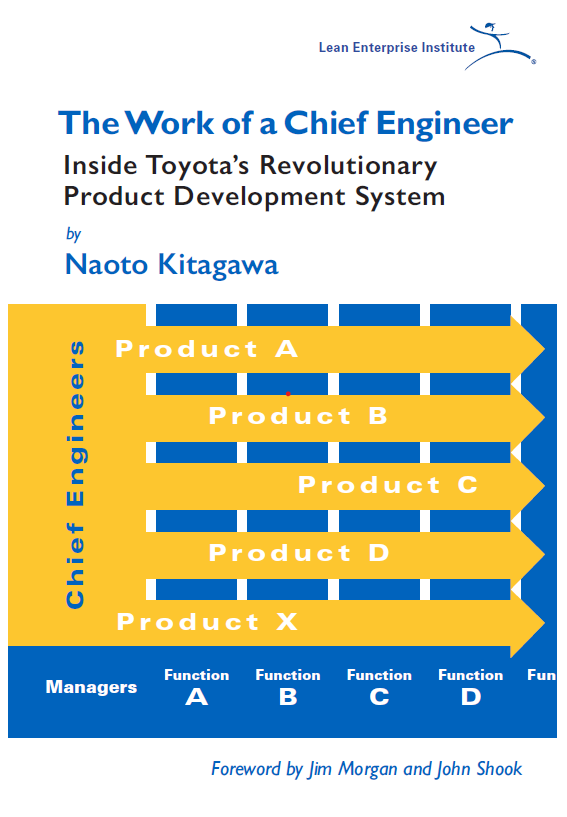
For about 75 years, the chief engineer has sat at the center of how Toyota develops products. The role carries full responsibility for whether a vehicle succeeds, with almost no formal authority over the thousands of people who build it. Until now, no one who held the job had told the story from the inside.
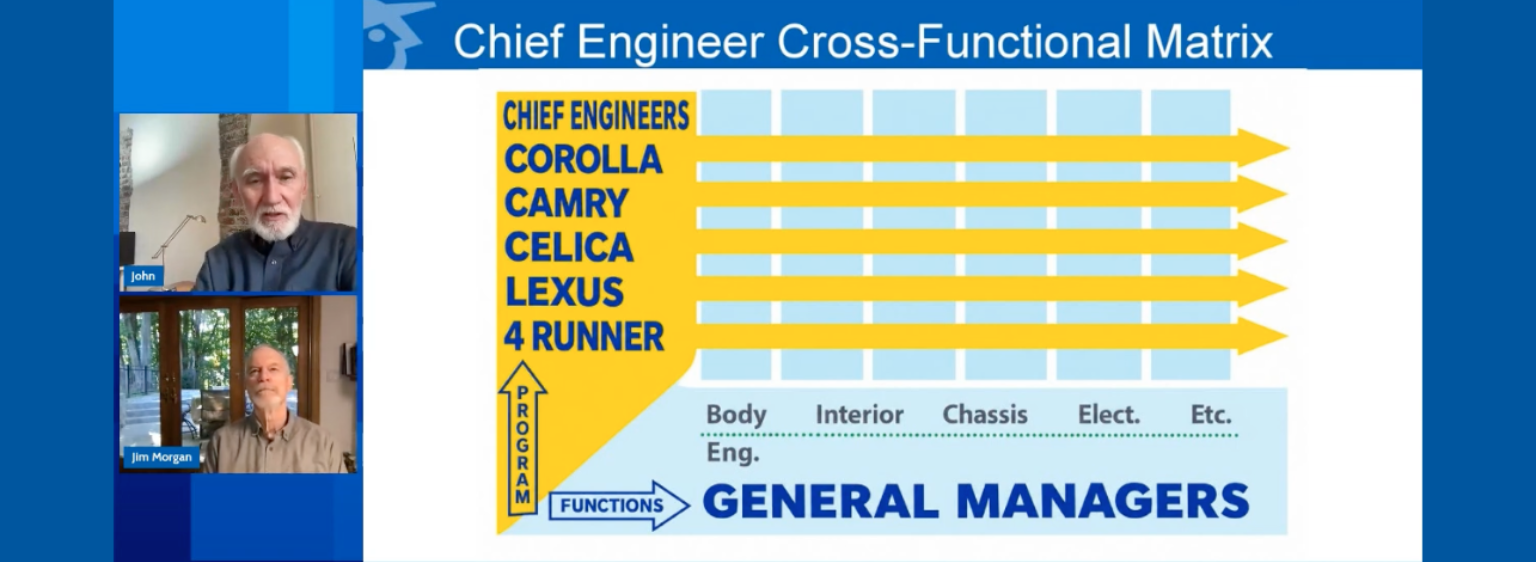
Naoto Kitagawa did. He was chief engineer for the Camry, bB, Avalon, Solara, and Corolla, and his new book is the first inside account of the role in English. In this recorded conversation, Jim Morgan and John Shook, who wrote the book’s foreword, discuss what Kitagawa reveals and what it means for anyone developing products.
In this conversation
- Why the role is a paradox: vast responsibility paired with no authority, and how a chief engineer leads by influence instead. Kitagawa starts every program with a single sheet of paper, trimming the concept down until he can explain it to an expert engineer or a family member.
- How Toyota builds a product concept from direct customer understanding. For the Camry, Kitagawa fought cut travel budgets to get a small team into customers’ homes to see how they actually used their cars. It is the same instinct behind the Lexus chief engineer living in Bel Air and the Sienna chief engineer driving across North America.
- Why humility sits underneath it all. Kitagawa admitted his team did not know how to build a car for a younger generation, so he went to learn. Morgan contrasts that with the hubris he sees elsewhere, which he calls, quoting Nick Saban, “rat poison.”
- Why the system travels beyond Toyota. Morgan points to the chief engineer role as a path for future executives, and to results at partner company TechnipFMC, where a chief engineer led a subsea program that delivered half the parts and half the weight at lower cost.
This is a fraction of what Kitagawa covers. Read the full account of a career spent in the chief engineer’s chair.