In 2016, 35 people from five companies spent two days at GE Appliances’ Appliance Park in Louisville, Kentucky as part of a new LEI learning group focused on lean product and process development (LPPD). GE Appliances took the visitors through its craftsmanship lab, and LEI’s report from the event called it “an eye opener for the whole group.” Kevin Nolan, then the company’s vice president of technology and development, explained why GE Appliances had joined. Product development was “critical to the success of a company,” he said, but “very hard to ‘go and see’ and learn from world-class companies.”
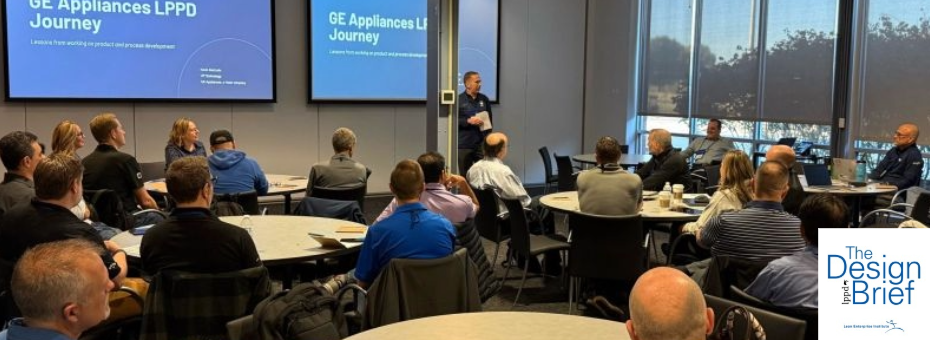
This October, the group came back. Forty-two leaders (CEOs, CTOs, VPs, and product leaders) from both old and new partner companies spent two days at Appliance Park. Nolan is now CEO of GE Appliances and the craftsmanship work that surprised everyone a decade ago now has a virtual reality room of its own and is part of every product program.
Ten years is long enough to find out whether learning alongside other companies changes anything. At Appliance Park, you could see the answer on the walls.
What the group went to see
Every company brought something from its own LPPD experiments to report on. As host, GE Appliances took the group to see five things firsthand.
One was the obeya for a development program now under way. The second was an obeya of a different kind, built for the company’s newly revamped new product introduction (NPI) process. Seeing the two rooms one after the other illustrated how improving a program and improving the system every program runs through are different jobs. GE Appliances is working on both.
The third stop was the VR room the company uses for its craftsmanship initiative, where design engineers evaluate fit and finish before tooling is cut. Next was the area where a new production line for the company’s combo washer-dryer is being designed and set up. That stop is the one Jim Morgan, the LEI senior advisor who started this learning group, talks about in the video below.
The final stop required the group to leave Appliance Park. FirstBuild is GE Appliances’ open innovation hub, established in partnership with the University of Louisville and opened on its campus by Nolan in 2014. It brings together small teams of engineers and designers who work directly with the community to develop new products around customer needs. Nolan has called it “a Venn diagram of people who loved appliances, people who were makers and passionate end users.” Through prototyping, crowdfunding, and small production runs, FirstBuild helps test demand and shorten the path from idea to market. The Opal Nugget Ice Maker started this way and eventually became part of GE Appliances’ broader product portfolio. More recently, FirstBuild’s Sourdough Sidekick, developed in collaboration with King Arthur Baking Company and consumers, was named one of TIME’s Best Inventions of 2026. FirstBuild shows one way to learn what customers will buy before anyone commits to tooling a production line.
Companies tend to treat speed and quality as a trade-of, they need to pursue both at once, LPPD makes that possible.
To close out the meeting after every company had shared, Morgan gave a talk on delivering speed and quality in product development. Companies tend to treat speed and quality as a trade-off. His argument was that they need to pursue both at once, and that LPPD makes that possible through front-loading the development process, creating flow, rooting out waste, and building an enabling management system.
Why the rules matter
The group’s ground rules are simple. Partner companies don’t compete and they sign nondisclosure agreements, so they can bring their failures along with their successes. Polished success stories teach less than a program that’s halfway done and in trouble. Senior leaders show up in person, and leadership of the meeting rotates.
“Each company takes a turn hosting, so the learning is much richer and sharing is more authentic,” says Morgan. “Since we meet on a regular cadence, LPPD partners can track each other’s progress, which builds accountability into the process. We have elite coaches working with the partners, and I take my role shepherding this process seriously.”
That accountability is hard to get any other way. A consultant’s engagement ends. A conference talk is a highlight reel. But when the same executives come back and ask what came of an experiment you described last time, you need an answer. This October, some of them could compare what they saw with what they had seen in the same buildings ten years earlier.
The host company learns the most
Morgan studied Toyota’s product development system for many years before taking senior executive leadership roles at Ford and Rivian. He argues that in the best lean organizations, learning and sharing are two sides of the same coin. Toyota set up the Toyota Production System Support Center (TSSC) to teach other companies. Plus, its plants have long hosted visitors, competitors included. That isn’t charity. Explaining your system to capable outsiders makes you look at it again and visitors’ questions expose what you’ve stopped seeing.
Every company in the room shares, but the host shares the most. To show other companies how you develop products, you must first make your own process clear enough to explain. Then you stand in your own obeya while people who run development organizations of their own ask why you do it that way. Nolan said as much in 2016: the meeting GE Appliances hosted “showed us clear areas where we can improve.”
What a decade of practice looks like
GE Appliances was named the No. 1 most reliable appliance brand in J.D. Power’s 2025 U.S. Appliance Reliability & Service Study. In 2025, the company also announced a $3 billion, five-year investment plan to expand U.S. manufacturing, bring more production to America, and modernize its operations. More recently, GE Appliances received the Kentucky Association of Manufacturers’ 2026 Large Manufacturer of the Year award. Many things go into results like these. A learning group is only one of them.
Awards don’t show how a company learns; its programs do. Take the next-generation dishwasher, an $80 million program and the first GE Appliances launched during the pandemic. The program’s director and her team found that tracking tasks and timing in its obeya didn’t tell them everything she wanted to know about how the project was actually progressing. So the cross-functional sub-teams mapped the critical decisions the program would need to make and when it would need them. LEI coach John Drogosz, who developed decision-flow mapping with several partners, wrote up the dishwasher team’s experience so the rest of the group could learn from it. Experiments like that are what the partners bring to each meeting.
The conversation
During the October meeting, Morgan joined Nolan on camera. In three minutes, he makes a point that is sometimes missed in talks about the Toyota Production System: it “doesn’t work without the product development in front,” including the manufacturing engineers who build the tools, fixtures, and special machines alongside the product engineers. He calls that Toyota’s “often-overlooked secret sauce even by long time TPS folks who can tend to take it for granted.” He also describes the obeya that the team set up at Rivian to make the large, complex task of developing two all new vehicles, building a leadership team, and standing up an assembly and stamping plant simultaneously visible to everyone involved. Finally, he explains why he believes US manufacturers have lost much of their know-how about making things well. Nolan’s response: “That’s exactly what we’re trying to do here.”
Watch the conversation below and consider what your own organization might show if four peer companies arrived next month. What you would want them to ask about?
Related book