Lean Enterprise Institute Logo
  • Contact Us
  • Newsletter Signup
  • Cart (0)
  • Account
  • Search
Lean Enterprise Institute Logo
  • Explore Lean
        • What is Lean?
        • The Lean Transformation Framework
        • A Brief History of Lean
        • Lexicon Terms
        • Topics to explore
          • Operations
          • Lean Product and Process Development
          • Administration & Support
          • Problem-Solving
          • Coaching
          • Executive Leadership
          • Line Management
  • The Lean Post
        • Subscribe to see exclusive content
          • Subscribe
        • Featured posts
          Changing the Way New Value is Created with Lean Product and Process Development

          Design Brief | Reinventing Product Development: People...

          The Jidoka Learning Cycle diagram showing five connected stages: Problem Detected, Andon Stop, Problem Solved, Embed Learning, and Improved System in a continuous loop

          Lean AI Journal | The Assembly Line...

          • See all Posts
  • Events & Courses
        • 2026 Lean Summit
          March 12-13
        • Forms and Templates
        • Featured learning
          • From Toyota to Tech: Wiring Organizations to Win

            November 17, 2025 | Online

          • Managing in Time with Daily Management

            January 09, 2026 | Coach-Led Online Course

          • Managing on Purpose with Hoshin Kanri

            January 20, 2026 | Coach-Led Online Course

          • The Lean Management Program

            February 06, 2026 | Coach-led Online Program

          • See all Events
  • Training & Consulting for Organizations​
        • Interested in exploring a partnership with us?
          • Schedule a Call
        • Getting Started with Lean Thinking and Practice
        • Leadership Development
        • Custom Training
        • Lean Enterprise Transformation​
        • Case Studies
  • Store
        • Book Ordering Information
        • Shopping Cart
        • Featured books
          Changing the Way New Value is Created with Lean Product and Process Development

          Daily Management to Execute Strategy: Solving problems and developing people every day

          Managing on Purpose Workbook

          Managing on Purpose

          • See all Books
  • About Us
        • Our people
          • Senior Advisors and Staff
          • Faculty
          • Board of Directors
        • Contact Us
        • Lean Global Network
        • Press Releases
        • In the News
        • Careers
        • About us

The Lean Post / Articles / Changing the Way New Value is Created with Lean Product and Process Development

Changing the Way New Value is Created with Lean Product and Process Development

Product & Process Development

Changing the Way New Value is Created with Lean Product and Process Development

By James Morgan, PhD

September 25, 2020

Learn the six guiding principles of LPPD and why they are critical to successful new product, process, and service development.

FacebookTweetLinkedInPrintComment

Jim Morgan, PhD, author, and LEI senior advisor of LPPD at the Lean Enterprise Institute, previews the six guiding principles of LPPD and explains why they are critical to the successful new product, process, and service development. Morgan developed the principles over 20 years of working with organizations–including as a product development executive at Ford, and most recently, COO of startup Rivian–to improve their product, process, and service development capabilities.

Product development is essentially about creating new value, whatever form that value might take–a service, a physical product, a process–and the impact that it can have on an organization is absolutely massive because it represents all of the value-creating activities that are ongoing in that organization. If it’s fragmented, you can create silos in your organization. And it can lead to delays, cost overruns quality problems. It can do tremendous damage both to the culture of the organization and to the overall performance of the organization.

So if you’re thinking about improving your product and process development system, we want to provide some guiding principle in the sense that we want to share what good looks like.

What’s so powerful about lean product and process development is that it takes a systems approach to improving your development performance. It works with people, with processes, and technologies in order to optimize the overall system.

What’s so powerful about lean product and process development is that it takes a systems approach to improving your development performance.

But people can become very dogmatic about their lean, which can limit their thinking, their ability to innovate, and their opportunity to make these principles their own.

These principles have evolved over 20-some years of working with organizations on their product development capability. And in that work, we’ve identified six guiding principles or key characteristics of effective development systems.
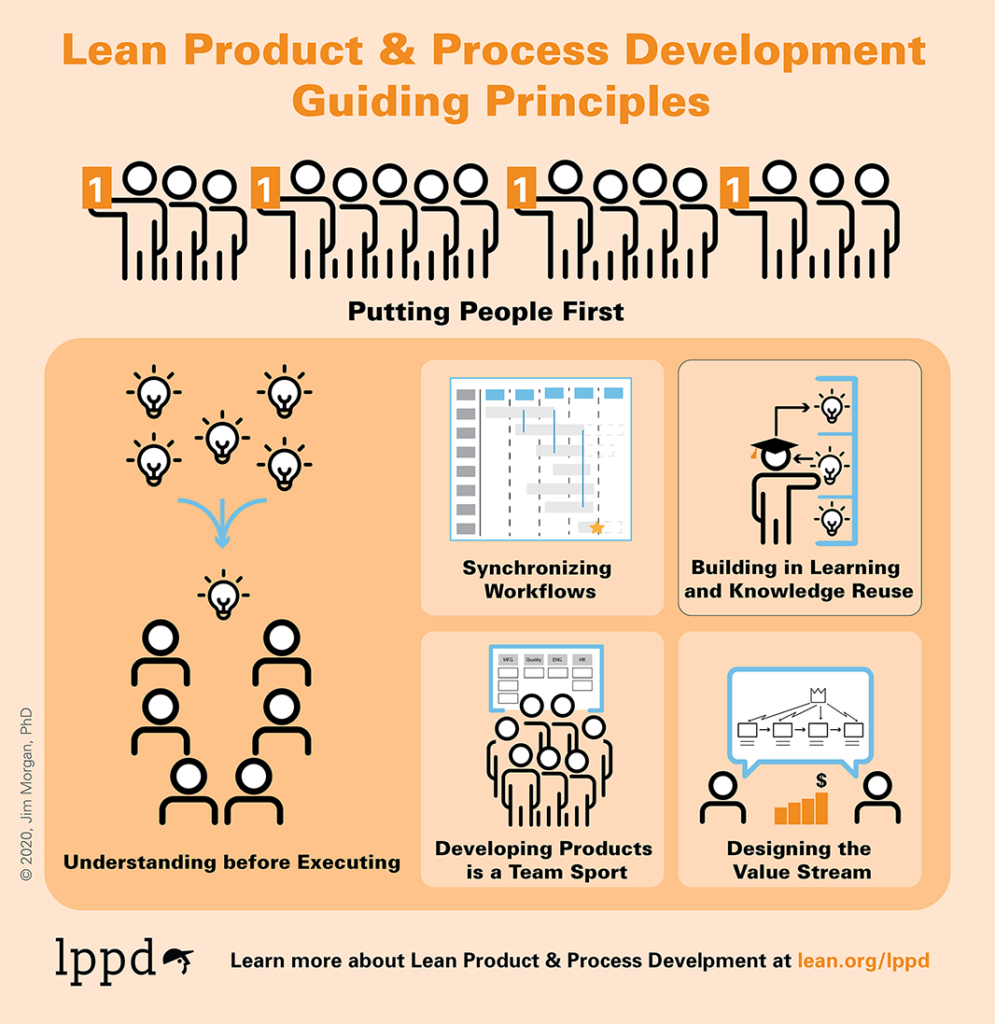
Lean Product and Process Development principles
  1. Putting People First: Organizing your development system and using lean practices to support people to reach their full potential and perform their best sets up your organization to develop great products and services your customers will love.
  2. Understanding before Executing: Taking the time to understand your customers and their context while exploring and experimenting to develop knowledge helps you discover better solutions that meet your customers’ needs. 
  3. Developing Products is a Team Sport: Leveraging a deliberate process and supporting practices to engage team members across the enterprise from initial ideas to delivery ensures that you maximize value creation.
  4. Synchronizing Workflows: Organizing and managing the work concurrently to maximize the utility of incomplete yet stable data enables you to achieve flow across the enterprise and reduce time to market.
  5. Building in Learning and Knowledge Reuse: Creating a development system that encourages rapid learning, reuses existing knowledge, and captures new knowledge to make it easier to use in the future helps you build a long-term competitive advantage. 
  6. Designing the Value Stream: Making trade-offs and decisions throughout the development cycle through a lens of what best supports the success of the future delivery value stream will improve its operational performance.

These principles have been successfully applied to a wide variety of industries from automotive to sub-sea to consumer electronics, appliances, heavy equipment, and even a clinical process in a healthcare environment. Our aim is to continue to grow our community, to help other organizations improve their development capabilities and their work environment. So I hope you’ll join us in changing the way new value is created.

FacebookTweetLinkedInPrintComment

Written by:

James Morgan, PhD

About James Morgan, PhD

Jim is a senior advisor at Lean Enterprise Institute and a board member at Adrian Steel. He has a unique blend of industry leadership experience and rigorous scholarship, which he draws upon to improve organizational performance at a select group of companies.  Jim’s most recent industry experience was as Chief…

Read more about James Morgan, PhD

Leave a Comment Cancel reply

Your email address will not be published. Required fields are marked *

Related

Design Brief | Reinventing Product Development: People First, Technology Second 

Product & Process Development

Design Brief | Reinventing Product Development: People First, Technology Second 

Article by James Morgan, PhD

The Jidoka Learning Cycle diagram showing five connected stages: Problem Detected, Andon Stop, Problem Solved, Embed Learning, and Improved System in a continuous loop

Problem Solving

Lean AI Journal | The Assembly Line of Code: an Interactive Story on the Industrialization of Software

A blog banner image visualizing the lean concept of "jidoka" (built-in quality) applied to AI. A digital assembly line stops a "defective" data block at a red quality gate, complete with an "andon" warning light, while "good" green blocks pass inspection. This illustrates the article's theme of industrializing AI with lean principles.

Problem Solving

Lean AI Journal | Industrializing AI for Software Development Offers an AI Roadmap for All

Related books

The Power of Process book cover

The Power of Process – A Story of Innovative Lean Process Development

by Eric Ethington and Matt Zayko

Welcome Problems, Find Success – Creating Toyota Cultures Around the World

Welcome Problems, Find Success – Creating Toyota Cultures Around the World

by Nate Furuta

Related events

February 09, 2026 | Coach-Led Online Course

Designing the Future Using Lean Product and Process Development

Learn more

Online – On-Demand, Self-Paced

Lean Product and Process Development Overview 

Learn more

Explore topics

Product and Process Development graphic icon Product & Process Development
Coaching graphic icon Coaching
Executive Leadership graphic icon Executive Leadership
  • Privacy Policy
  • Sitemap
  • LinkedIn
  • Twitter
  • YouTube
  • Instagram
  • Facebook

©Copyright 2000-2025 Lean Enterprise Institute, Inc. All rights reserved.
Lean Enterprise Institute, the leaper image, and stick figure are registered trademarks of Lean Enterprise Institute, Inc.

This website uses cookies to improve your experience. We'll assume you're ok with this, but you can opt-out if you wish. Learn More. ACCEPT
Privacy & Cookies Policy

Privacy Overview

This website uses cookies to improve your experience while you navigate through the website. Out of these cookies, the cookies that are categorized as necessary are stored on your browser as they are essential for the working of basic functionalities of the website. We also use third-party cookies that help us analyze and understand how you use this website. These cookies will be stored in your browser only with your consent. You also have the option to opt-out of these cookies. But opting out of some of these cookies may have an effect on your browsing experience.
Necessary
Always Enabled
Necessary cookies are absolutely essential for the website to function properly. This category only includes cookies that ensures basic functionalities and security features of the website. These cookies do not store any personal information.
Non-necessary
Any cookies that may not be particularly necessary for the website to function and is used specifically to collect user personal data via analytics, ads, other embedded contents are termed as non-necessary cookies. It is mandatory to procure user consent prior to running these cookies on your website.
SAVE & ACCEPT