Lean Enterprise Institute Logo
  • Contact Us
  • Newsletter Signup
  • Cart (0)
  • Account
  • Search
Lean Enterprise Institute Logo
  • Explore Lean
        • What is Lean?
        • The Lean Transformation Framework
        • A Brief History of Lean
        • Lexicon Terms
        • Topics to explore
          • Operations
          • Lean Product and Process Development
          • Administration & Support
          • Problem-Solving
          • Coaching
          • Executive Leadership
          • Line Management
  • The Lean Post
        • Subscribe to see exclusive content
          • Subscribe
        • Featured posts
          coach mentoring two young employees

          Raising the Floor and the Ceiling: How...

          Leaders at GE Appliances kicking off LPPD Learning Group

          Back at Appliance Park, Ten Years Later

          • See all Posts
  • Events & Courses
        • 2027 Lean Summit
          March 16-17
        • Forms and Templates
        • Featured learning
          • Lean Leadership Learning Tour

            November 09, 2026 | Kentucky

          • 2026 Lean Global Connection

            November 12, 2026

          • Building a Lean Operating and Management System 

            November 19, 2026 | Morgantown, PA

          • Managing in Time with Daily Management

            January 15, 2027 | Coach-Led Online Course

          • See all Events
  • Consulting & Training for Organizations​
        • Interested in exploring a partnership with us?
          • Schedule a Call
        • Getting Started with LEI
        • Enterprise Workshops and Training
        • Leadership Development
        • Lean Product and Process Development
        • Lean Enterprise Transformation​
        • Case Studies
  • LeanAI
  • Store
        • Book Ordering Information
        • Shopping Cart
        • Featured books
          Building a Problem-Solving Culture: Insights from Barton Malow’s Lean University

          The Work of a Chief Engineer: Inside Toyota’s Revolutionary Product Development System

          Building a Problem-Solving Culture: Insights from Barton Malow’s Lean University

          Daily Management to Execute Strategy: Solving problems and developing people every day

          • See all Books
  • About Us
        • Our people
          • Senior Advisors and Staff
          • Faculty
          • Board of Directors
        • Contact Us
        • Lean Global Network
        • Press Releases
        • In the News
        • Careers
        • About us

The Lean Post / Articles / Developing People Not Robots Through Karakuri

Article graphic image with repeating icons

Coaching

Developing People Not Robots Through Karakuri

By Matthew Savas

April 5, 2018

"Karakuri demonstrates that Toyota’s working currency is brainpower, grown through rigorous problem-solving and mentors who challenge their students," writes Matt Savas, "The wallet takes a backseat to the brain."

FacebookTweetLinkedInPrintComment

While reading Jeff Liker’s recent Tesla article exploring contrasting viewpoints about the right level of automating work, I couldn’t help but reflect on a recent visit to Toyota Motor Kyushu, or TMK. Last month Mark Reich and I spent two days there walking the gemba. TMK is a wholly-owned subsidiary of Toyota Motor Corporation, based just outside Fukuoka City on the island of Kyushu. Toyota created TMK in the 1980’s to manufacture its then new Lexus brand. It continues to manufacture Lexus vehicles — one every 72 seconds during our time at the plant.

In his article, Liker reflects on the future relationship between man and machine, specifically on the question of whether the dream of full automation should indeed be an ideal future state. I got a sense of Toyota’s current thinking about this very question during my time there, and was intrigued by what I learned. Indeed, the TMK looks less like a factory from the future and more like a factory from the past. This is primarily due to something called “karakuri.”

Karakuri literally means a type of doll that moves with simple mechanics. In manufacturing, karakuri refers to simplified engineering for kaizen. Team leaders and operators are challenged to use levers, pulleys, counterweights, and gravity in order to increase productivity, quality, and safety. Utilization of compressed air, hydraulics, and robotics is prohibited. It’s as if TMK is trying to build the Lexus RX and CT on a shoestring budget. The roughly $186 billion (as of this writing) market cap company is bootstrapping its luxury vehicle assembly!

Karakuri is easily understood when observing it, but more difficult to understand through words alone. I have (poorly) illustrated one example that I witnessed in assembly. While I am not certain of the precise function of the apparatus, this illustration is based on what I gathered from observation. The parts container adjacent to the operator sits on a sort of trapdoor that is connected by a string to a partially-filled water bottle serving as a counterweight. Once the parts container empties, the counterweight falls, triggering the floor beneath the container to open. The container slides down a shoot for pickup by the material handler, while a full parts container slides into place for use. This karakuri removes the operator’s periodic work of taking down the empty parts container.
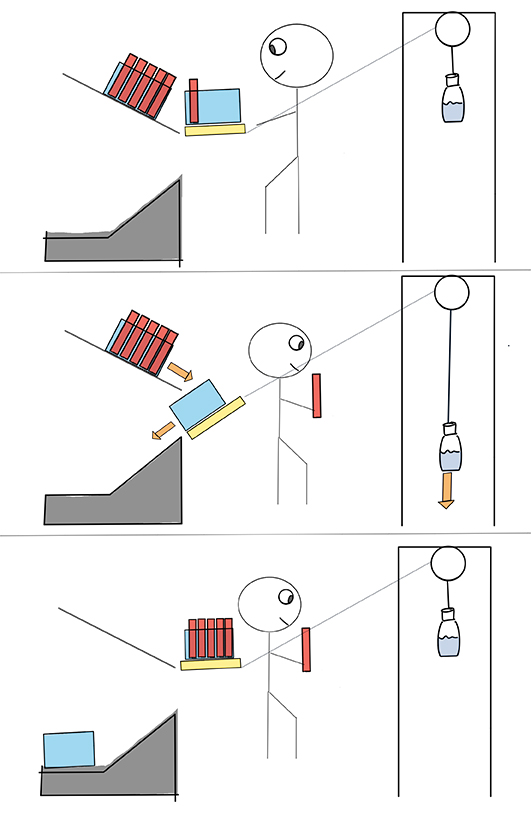
karakuri

This is but one of dozens of examples that exist along the TMK assembly line. The proliferation of karakuri is driven by a two-year training program for team leaders. Coaches skilled in karakuri spend the first year training team leaders on karakuri engineering methods; they spend the second year teaching others how to lead operators practicing karakuri. The link between improving the work and developing people is explicit. Team leaders aren’t just challenged to improve the work through karakuri themselves; they’re challenged to coach their team members to do the same.

Karakuri demonstrates that Toyota’s working currency is brainpower, grown through rigorous problem-solving and mentors who challenge their students. The wallet takes a backseat to the brain. Toyota’s response to the challenge of increasing kaizen capability wasn’t to find smarter people or more clever machines. Instead, it was to 1) make kaizen more accessible by simplifying engineering and 2) develop people to make work better using the engineering.

It’s unknown what this specific factory tells about what all future factories will look like, but does provide an alternative scenario than the fully automated system some envision. Tesla is betting on a highly-automated factory in which some humans support a whole lot of robots: complex machinery supported by concentrated human capability. Toyota — at least for now — thinks it will have some robots supporting a lot of humans: simple machinery supporting distributed capability.

Thus far, Toyota is winning the argument. Clever use of pulleys, counterweights, and gravity by assembly workers is outperforming pricey robots trained by highly educated engineers.

This is not to say that Tesla can’t get to where it wants to go. It may very well build a lights-out factory churning out a million Model 3 vehicles a year (assuming customers want a million Model 3 vehicles per year). But its current state is what even its founder Elon Musk refers to as “production hell”, while TMK has been a J.D. Power Platinum plant for two years running.

What we can conclude for now is that TMK is producing the highest quality vehicles in the world by making ever-clever people and using ever simpler tools. For those anxious about the future relationship between humans and robots (who works for who or do humans work at all?) TMK offers reason to hope that humans will win the race — or at the very least have a long runway on which to run.

People are very good at making things, and at making things better. It seems that Toyota is betting that this won’t change anytime soon. For the time being, as a means of thriving in the future, they are investing in people and pulleys rather than robots.


FacebookTweetLinkedInPrintComment

Written by:

Matthew Savas

About Matthew Savas

Matt Savas is the founder of Kaizumi, an AI-powered lean training platform. Prior to Kaizumi, Matt worked at the Lean Enterprise Institute and Lean Global Network for over a decade.  

Leave a Comment Cancel reply

Your email address will not be published. Required fields are marked *

Related

WLEI Barton Malow Podcast

Coaching

Building a Problem-Solving Culture: Insights from Barton Malow’s Lean University

Podcast by Matthew Savas

experiements

Coaching

Lean Was Always an Experiment 

Article by Josh Howell

hands holding profile images with gears being shared to coney knowledge transfer

Coaching

Toyota’s Answer to Knowledge Walking Out the Door

Article by Fran Noto

Related books

A3 Getting Started Guide 2

A3 Getting Started Guide

by Lean Enterprise Institute

The Gold Mine (Audio CD)

The Gold Mine (Audio CD)

by Freddy Ballé and Michael Ballé

Related events

November 12, 2026

2026 Lean Global Connection

Learn more

February 05, 2027 | Coach-led Online Program

The Lean Management Program

Learn more

Explore topics

Coaching graphic icon Coaching
Administration & Support graphic icon Administration & Support
Line Management graphic icon Line Management
  • Privacy Policy
  • Sitemap
  • LinkedIn
  • Twitter
  • YouTube
  • Instagram
  • Facebook

©Copyright 2000-2026 Lean Enterprise Institute, Inc. All rights reserved.
Lean Enterprise Institute, the leaper image, and stick figure are registered trademarks of Lean Enterprise Institute, Inc.

This website uses cookies to improve your experience. We'll assume you're ok with this, but you can opt-out if you wish. Learn More. ACCEPT
Privacy & Cookies Policy

Privacy Overview

This website uses cookies to improve your experience while you navigate through the website. Out of these cookies, the cookies that are categorized as necessary are stored on your browser as they are essential for the working of basic functionalities of the website. We also use third-party cookies that help us analyze and understand how you use this website. These cookies will be stored in your browser only with your consent. You also have the option to opt-out of these cookies. But opting out of some of these cookies may have an effect on your browsing experience.
Necessary
Always Enabled
Necessary cookies are absolutely essential for the website to function properly. This category only includes cookies that ensures basic functionalities and security features of the website. These cookies do not store any personal information.
Non-necessary
Any cookies that may not be particularly necessary for the website to function and is used specifically to collect user personal data via analytics, ads, other embedded contents are termed as non-necessary cookies. It is mandatory to procure user consent prior to running these cookies on your website.
SAVE & ACCEPT