Lean Enterprise Institute Logo
  • Contact Us
  • Newsletter Signup
  • Cart (0)
  • Account
  • Search
Lean Enterprise Institute Logo
  • Explore Lean
        • What is Lean?
        • The Lean Transformation Framework
        • A Brief History of Lean
        • Lexicon Terms
        • Topics to explore
          • Operations
          • Lean Product and Process Development
          • Administration & Support
          • Problem-Solving
          • Coaching
          • Executive Leadership
          • Line Management
  • The Lean Post
        • Subscribe to see exclusive content
          • Subscribe
        • Featured posts
          A blog banner image visualizing the lean concept of "jidoka" (built-in quality) applied to AI. A digital assembly line stops a "defective" data block at a red quality gate, complete with an "andon" warning light, while "good" green blocks pass inspection. This illustrates the article's theme of industrializing AI with lean principles.

          Lean AI Journal | Industrializing AI for...

          Designed In Quality

          The Management Brief | Steven Spear Talks...

          • See all Posts
  • Events & Courses
        • 2026 Lean Summit
          March 12-13
        • Forms and Templates
        • Featured learning
          • From Toyota to Tech: Wiring Organizations to Win

            November 17, 2025 | Online

          • Managing in Time with Daily Management

            January 09, 2026 | Coach-Led Online Course

          • Managing on Purpose with Hoshin Kanri

            January 20, 2026 | Coach-Led Online Course

          • The Lean Management Program

            February 06, 2026 | Coach-led Online Program

          • See all Events
  • Training & Consulting for Organizations​
        • Interested in exploring a partnership with us?
          • Schedule a Call
        • Getting Started with Lean Thinking and Practice
        • Leadership Development
        • Custom Training
        • Lean Enterprise Transformation​
        • Case Studies
  • Store
        • Book Ordering Information
        • Shopping Cart
        • Featured books
          Designed In Quality

          Daily Management to Execute Strategy: Solving problems and developing people every day

          Managing on Purpose Workbook

          Managing on Purpose

          • See all Books
  • About Us
        • Our people
          • Senior Advisors and Staff
          • Faculty
          • Board of Directors
        • Contact Us
        • Lean Global Network
        • Press Releases
        • In the News
        • Careers
        • About us

The Lean Post / Articles / Designed In Quality

Designed In Quality

Product & Process Development

Designed In Quality

By James Morgan, PhD

March 19, 2019

Extraordinary quality is not only designed into the product, it is designed into the development process itself, says Jim Morgan, who suggests that the next time you might be tempted to minimize Toyota’s quality performance, you will think about how Toyota’s principles and practices might help you design-in better quality in your products and processes.

FacebookTweetLinkedInPrintComment

I almost skipped over the recent USA TODAY headline; “Toyota and Lexus Top List of Most Reliable Cars,” thinking there are three things you can count on in life; death, government dysfunction, and Toyota quality.  After all, Toyota and Lexus have been at, or near the top of every quality list for more than 20 years.  In fact, some people even see Toyota reliability as kind of boring – as if it were a knock against the company. That type of thinking indicates that the person doesn’t really understand what an astounding accomplishment this really is. Given the exponential growth in potential failure modes in today’s incredibly complex vehicles (advanced safety systems, infotainment, driver assist, powertrain, lights, and even the hundreds of mechanisms that enable doors and windows), and the highly competitive environment in which Toyota operates, this is an almost unbelievable accomplishment.

Reliability is fundamental to creating customer value. It means the product will perform as the customer expects, and it will do it consistently over time. It is essentially what quality experts W. Edwards Deming and Koriaki Kano were talking about when they described “fit for use” back when companies cared about such things.  And the more complex the product, the more difficult this task becomes.

Begin in Development

There is no doubt that the Toyota Production System (TPS) and its focus on building in quality is a major reason for Toyota’s extraordinary performance in this area. However, it will likely not come as a surprise that their focus on quality starts long before vehicles are flowing down the assembly line. It starts in Toyota’s development process with a robust and proactive approach to designing in quality.  To do this Toyota harnesses its formidable organizational learning capability to determine the likelihood that a specific design will experience issues in the field and design-in appropriate countermeasures. This system was eventually formalized as Mizenboushi and introduced outside of Toyota by Professor Tatsuhiko Yoshimura of Kyushu University.

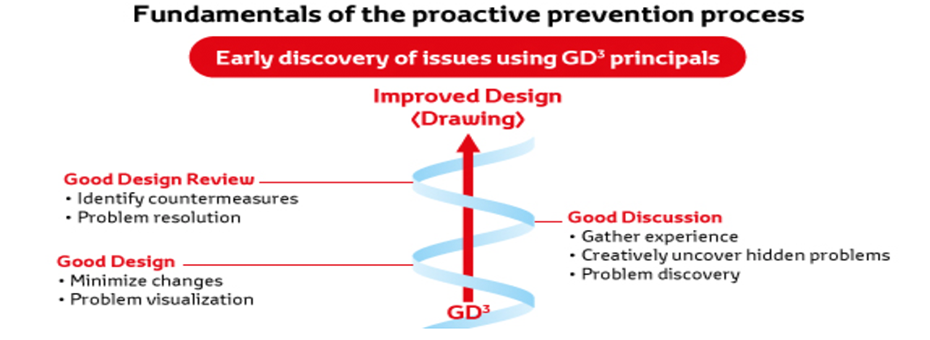
In Yoshimura’s book Toyota Styled Mizenbushi Method – GD3 Preventative Measures – How to Prevent a Problem Before it Occurs (JUSE Press Ltd. Tokyo 2002) he describes the three phases of the process as; good design, good discussion and good dissection.

Good design emphasizes creating robust designs by reusing proven components and proven design characteristics wherever possible.  It also focuses on limiting the amount and severity of changes that impact a single subsystem.  And finally,product features are designed such that they will make a budding problem apparent as early as possible. A bit like a smoke detector will chirp when the battery gets low. 

Good discussion drives cross-functional analysis and debate especially focused on any new features, new parts, and all critical interfaces. The specific forum for this debate is referred to as design review based on failure mode (DRBFM) and prioritizes areas of potential risk.  Yoshimura claims that this process is both more robust and efficient than traditional failure mode and effects analysis (FMEA) because it is a more focused approach.

Good dissection is a method for analyzing test results that starts with a detailed review of any signs of unacceptable or inconsistent performance during testing.  Parts from completed tests are dissected and closely studied for any signs of wear or degradation that might signal a potential weakness in design. Yoshimura also introduced a tool to help enable this process “design review based on test results” that enables debate and captures learning to further strengthen the mizenbushi system.

Ask Chief Engineers

In the research for our recently published book Designing the Future, my co-author Jeff Liker and I questioned several Toyota and Lexus chief engineers to understand how this process works at the vehicle level. Randy Stephens, the chief engineer (CE) for the 2018 Avalon and responsible for the vehicle’s overall quality, explained how all the individual engineering problem-prevention work was brought together at the program level.

This is how Stephens described the process:  There are between three and four cadenced design quality reviews that take place a few weeks prior to every major milestone.  At those reviews, each of the various engineering groups reviews their testing and documentation with the CE. These reviews may take place at the car, at the build or test site, and with the specific parts, depending on the topics to be covered. It often requires a couple of weeks for the CE to get through all the data generated from these reviews. The CE is required to sign off that the vehicle is at the appropriate level of quality relative to each milestone in the project. The final review is just before launch, and then requires a signoff on quality as well as safety as part of the “handover” to production.

So, it seems that extraordinary quality is not only designed into the product, it is designed into the development process itself.  Designed in quality indeed.  Perhaps the next time you might be tempted to minimize Toyota’s quality performance, you will think about what a significant accomplishment it truly is.  But more importantly, I hope you will think about how Toyota’s principles and practices might help you design-in better quality in your products and processes.

FacebookTweetLinkedInPrintComment

Written by:

James Morgan, PhD

About James Morgan, PhD

Jim is a senior advisor at Lean Enterprise Institute and a board member at Adrian Steel. He has a unique blend of industry leadership experience and rigorous scholarship, which he draws upon to improve organizational performance at a select group of companies.  Jim’s most recent industry experience was as Chief…

Read more about James Morgan, PhD

Leave a Comment Cancel reply

Your email address will not be published. Required fields are marked *

Related

A blog banner image visualizing the lean concept of "jidoka" (built-in quality) applied to AI. A digital assembly line stops a "defective" data block at a red quality gate, complete with an "andon" warning light, while "good" green blocks pass inspection. This illustrates the article's theme of industrializing AI with lean principles.

Problem Solving

Lean AI Journal | Industrializing AI for Software Development Offers an AI Roadmap for All

Sketch drawing of an Obeya room with charts and graphs on wall and large table and chairs in middle

Product & Process Development

The Design Brief | Obeya Principles for Visualizing Product Development, In-Person or Virtual

Article by Lex Schroeder

The Design Brief | The Competitive Advantage of Slowing Down in a Fast-Paced Digital World 

Product & Process Development

The Design Brief | The Competitive Advantage of Slowing Down in a Fast-Paced Digital World 

Article by Andrae Kirkland

Related books

The Power of Process book cover

The Power of Process – A Story of Innovative Lean Process Development

by Eric Ethington and Matt Zayko

Welcome Problems, Find Success – Creating Toyota Cultures Around the World

Welcome Problems, Find Success – Creating Toyota Cultures Around the World

by Nate Furuta

Related events

February 09, 2026 | Coach-Led Online Course

Designing the Future Using Lean Product and Process Development

Learn more

Online – On-Demand, Self-Paced

Lean Product and Process Development Overview 

Learn more

Explore topics

Product and Process Development graphic icon Product & Process Development
Operations graphic icon Operations
  • Privacy Policy
  • Sitemap
  • LinkedIn
  • Twitter
  • YouTube
  • Instagram
  • Facebook

©Copyright 2000-2025 Lean Enterprise Institute, Inc. All rights reserved.
Lean Enterprise Institute, the leaper image, and stick figure are registered trademarks of Lean Enterprise Institute, Inc.

This website uses cookies to improve your experience. We'll assume you're ok with this, but you can opt-out if you wish. Learn More. ACCEPT
Privacy & Cookies Policy

Privacy Overview

This website uses cookies to improve your experience while you navigate through the website. Out of these cookies, the cookies that are categorized as necessary are stored on your browser as they are essential for the working of basic functionalities of the website. We also use third-party cookies that help us analyze and understand how you use this website. These cookies will be stored in your browser only with your consent. You also have the option to opt-out of these cookies. But opting out of some of these cookies may have an effect on your browsing experience.
Necessary
Always Enabled
Necessary cookies are absolutely essential for the website to function properly. This category only includes cookies that ensures basic functionalities and security features of the website. These cookies do not store any personal information.
Non-necessary
Any cookies that may not be particularly necessary for the website to function and is used specifically to collect user personal data via analytics, ads, other embedded contents are termed as non-necessary cookies. It is mandatory to procure user consent prior to running these cookies on your website.
SAVE & ACCEPT