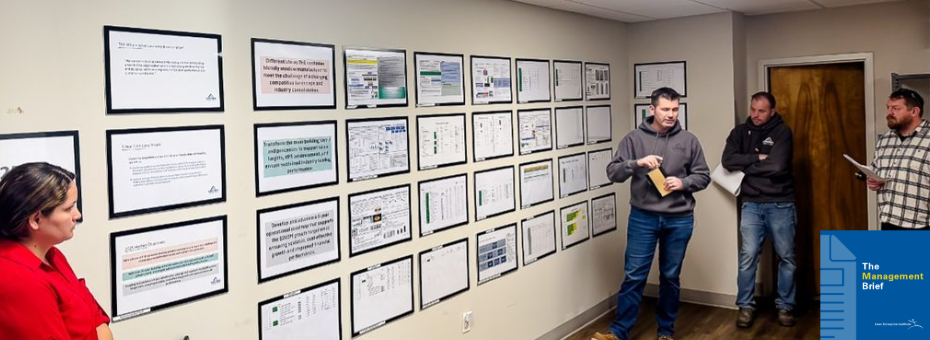
In this four-part series, LEI parses the lean improvements at Viwinco through a lens of the Lean Transformation Framework (LTF) questions.
All of the LTF questions need to be addressed to ensure a meaningful transformation; if applied a la carte, success is unlikely. The full Viwinco case study shows how the LTF components came together and resulted in dramatic changes.
This final article examines how Viwinco (a high-volume manufacturer of custom windows and doors based in Morgantown, Pennsylvania) addressed the fourth and fifth LTF questions:
- What management system — operating system and leadership behaviors — is required?
- What basic thinking, including mindsets and assumptions, is required by the organization as a purpose-driven socio-technical system?
Answering the two questions resulted in a management system (Viwinco Performance System) and support structure that aligned roles, behaviors, and performance targets across the company as well as a strategic planning process (hoshin kanri) that engaged everyone — vertically and horizontally — in developing, understanding, and pursuing key annual goals.
Viwinco Performance System

As improvements were made at Viwinco, components of a lean organization structure were emerging (e.g., gemba boards, end-of-shift report-outs) as well as gaps in management and leadership capabilities to manage the improvement process. “We can do the work in a line, but if we’re going to advance the whole organization and we’re going to sustain, we need to have this concept of a management system,” says Mike Duncan, President and CEO.
“When we started this with LEI, we were kind of pushing forward; the idea of actually formalizing it didn’t come until later,” says Duncan. “So it was a couple of years into it where we’re like, ‘OK, now let’s formalize this and call it something and then build that system out.’ So then we created the Viwinco Performance System and six components to really contextualize what this is and give us a roadmap to move forward. I think that was important.”
The six components of the Viwinco Performance System (VPS) are Core Tenets, Cascading Metrics and Initiatives, Standardization, Strategic and Daily Problem Solving, Capability Development, and Performance Management. Cascading Metrics and Initiatives connect the work to leadership and help each function, each line, know what it must do each day to support company objectives. Daily management cadence and tools monitor metrics (for KPIs and strategic projects), focus team leaders and supervisors on adherence to standardized work and rapid problem solving, and elevate problems that cannot be solved at the frontline.
“The beginning of the management system was just getting this KPI tree built out, and then building out the reporting structure and cadence at the lines, at the buildings, daily, weekly, monthly,” says Duncan. “And now that management system continues to grow. It’s a structure to help us continue to push forward, to sustain things, elevate problems, solve problems. Without that piece, it’s really challenging because it’s just this siloed work that gets done in certain places, and you can’t really stay on top of it. That management piece kind of came after and is starting to grow into a real comprehensive system.”
It took approximately a year to get the basic system in place, with the right information being shared and each line understanding if it’s ahead or behind on the day. A Core Tenet that helped the management system initially take hold is Sense of Urgency: rigor, relentlessness, and consistency of actions each and every day, from hourly monitoring meetings to weekly executive reviews.
Leadership continues to fine-tune the quality of data and how to leverage it, and they’re using the system to develop people: e.g., how leaders approach meetings (coaching questions) and how others prepare for those questions; individuals know what’s expected of them when coming into meetings wherever they’re occurring. Karen Gaudet, LEI Senior Coach, says as operations continues to change and improve, such as the line redesigns, it forces the management system to evolve as everyone takes on new sets of problems that arise.
Planning the Future with Hoshin Kanri
In 2024, leadership began a lean strategic-planning process — hoshin kanri — which is a far more structured approach to strategy than what occurred in the past. Duncan recalls that five years ago the company strategy would have been a 15- to 20-page document developed primarily by him.
“I basically built it, and it’s like, ‘Hey, here everybody, here’s our strategic plan, now just go execute.’ And go figure, it didn’t work,” says Duncan.
Viwinco’s initial hoshin kanri documented the five-year vision to inform decision-making and gathered inputs, such as business performance and customer feedback. From that an executive team developed a five-year company strategy that got everyone to ask: why are we doing this and how does it connect to the vision for the company? The team looked for the biggest barriers to address in order to move from current state to the five-year vision, which helped to establish objectives for the year. First-year challenges with hoshin kanri were wanting to set too many breakthrough goals and building and aligning plans vertically with people doing the work and getting the right feedback from them with catchball.
“It was a good first round. It was the first time they had come up with objectives in that way,” says Gaudet. “They had been used to just doing a lot. They have a huge appetite to do a lot of things. And part of their learning that they needed to have that year was starting to blend their traditional thinking with this hoshin kanri thinking and how you actually prioritize the organization at that point.”
With the first year of hoshin kanri under their belt, the second-year process for 2025 had a foundation for improvement. The executive team reflected on the previous year’s goals, achievements, and hoshin process, and gathered more inputs (customer feedback, KPI review, benchmarking, structured reflection of previous-year strategy, SWOT analysis) to identify barriers to the company vision. The team also locked in a process for selecting the right few breakthrough goals.
“They really did a much greater job of all of the inputs that needed to come in for that hoshin; they had really solid customer inputs, which was great, as well as inputs from the rest of the organization and the functions,” says Gaudet. The hoshin kanri improvements in 2025 led to more refinements and much better planning, “because they got to functional hoshin, which included resource and capacity planning to a detailed level they had never done before.”
The 2026 process has included more horizontal catchball (executive owner and executive supports that report to the executive team) and more vertical catchball by executive owners communicating plans and getting perspectives from people doing the work. Duncan says the emphasis on vertical catchball has been a large focus this year and has provided greater awareness to executives of what’s occurring throughout the company. “It gives a deeper understanding. If we’re not where we need to be at the company level and where the issue lies, it allows us to say, ‘We got to focus, try and focus on that area.’ It certainly has highlighted the specific areas that are contributing to not achieving our high-level objectives. Now solving those problems, that’s another thing.”
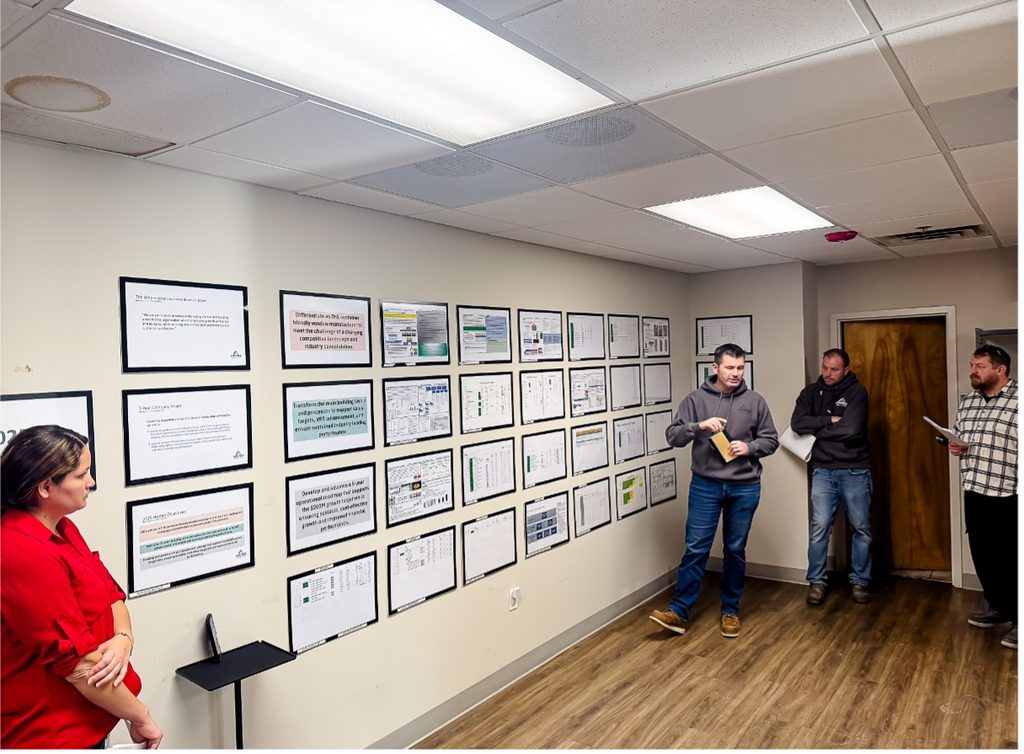
Three hoshin objectives identified for 2026, each posted in an obeya in the executive suite, are:
- Advancing the Viwinco Performance System and problem-solving capability,
- VIOP (integrated information flow across the organization), and
- One objective that is highly confidential.
Each hoshin objective has an A3 and A3 owner, and the functional leaders have tiered A3s that support the corporate A3s. An executive management system supports hoshin kanri and includes a weekly review of objectives, which is led by Duncan. During the review, each function reports out progress toward hoshin objectives.
Hoshin strategy and VPS are intertwined and evolving together. For example, the management system helps to standardize the type and number of meetings that exist within the company in order to manage the capacity of leaders and managers to review, plan, and take action, says Gaudet. Anything outside of those set meetings really needs to be questioned.
For example, executives have multiple A3s, and each A3 has 10 to 15 potential countermeasures that could be implemented and affect everyone in the organization, notes Gaudet. “So how do you even manage that rate of change, all the way through the organization, without losing your way in prioritization, getting extremely selective, or even discriminating about what you won’t spend time on or what you will spend time on? And then how does that actually marry up to the hoshin activities that need to continue to move forward?”
Lean Outcomes and Next Steps at Viwinco
At a company level, it can be difficult to identify specific improvements and claim they are the direct result of a lean transformation, even when it’s clear that the lean journey has steered the organization to its new performance location. “How do you put an ROI on things?” asks Duncan. “We didn’t really look at it 100% that way, like what was the financial benefit from everything we’re doing? I think we just knew, directionally, that it started to make more sense and continue to push that.”
Duncan says he sees a more professional operation as a result of lean along with impact to the business. “When I look at the performances of business as a whole, [we’ve been] able to double sales and continue growing, and from a profitability standpoint, make more money now in a month than we did in a year before. I think when you just look at overall business valuation in about a span of five years, it has been 12X. The business as a whole has tremendously transformed from a performance standpoint, and we were able to get out of some of the debt that we had and are really in a good financial position. Can I say lean single-handedly was the cause of that? No, but I look at it as a fundamental staple of what we do and how we operate. It had to play a huge part in supporting that.”
Performance measures prove Duncan’s point (see Viwinco Performance Improvement).” We’ve been able to support our customers and improve our consistency of performance to them, while also just totally transforming the business financially,” he adds.

“When I think about all of the incremental small changes they have made in four years’ time, it blows my mind,” says Gaudet. “None of this existed. They didn’t have team leaders. None of it existed. It’s pretty incredible. Their appetite, the leadership and the team’s appetite to take on change, is pretty outstanding.”
“It’s not perfect,” concedes Duncan. “It’s just this continual thing, and you got to have conviction that, directionally, it’s the right approach.”
David Barnes, owner and Chairman of the Board, says, “We stuck with it. I tell people I know, ‘It’s just a whole different style of management these days. It’s not a window company like we knew. It’s a manufacturing company.’ And it’s being treated and run as a manufacturing company.”
Operations improvements have increased capacity and allowed Viwinco to efficiently satisfy growing demand. As impressive are the increased capabilities of individuals throughout the company, both the growth of existing employees through training and development and the caliber of new hires. The company has raised the bar when hiring, being more selective about who to bring in and adopting a more challenging interview and new-hire training process.
Andrew Buczewski, Director of Operations, says he thought he had a lean background prior to the Viwinco transformation: “This place kind of redefined it for me. I did the whole lean master certification and all that stuff. I thought I knew it, but then coming here, working with Karen [Gaudet], working with LEI, it really kind of reshaped what lean really is. Plus the top-down support that we have from Mike [Duncan] that shows what a lean system looks like. I just had never had the opportunity to work in a real lean system. I learned more in the past two and a half years being here than I did in the previous 20 of my career.”
As lean continues to drive performance and improve company finances, it will enable Viwinco to continue to innovate, speed its pace of production, and differentiate itself from other, larger companies amid an atmosphere of industry consolidation (thus keeping the company independent). Next steps on the lean journey include:
- Reducing WIP to one-window flow across remaining lines — finishing that part of the transformation — and the continuing culture change required to do that.
- Sustaining gains by ensuring that standardized work is followed and regularly improved upon.
- Expanding lean to administrative and business processes, with coaching focused on developing problem-solving capability and the use of A3s in functions such as IT, Finance, HR, Maintenance, and Purchasing. Lean also is being deployed in product development, learning about and applying concepts of lean product and process development.
- Continuing to develop problem-solving capabilities, especially as one-piece flow makes every problem more visible.
Keys to Success
Viwinco did not begin its lean journey with an intentional, stated decision to follow the Lean Transformation Framework (LTF), as promoted by LEI. But, not surprisingly, the actions taken over the past four years answer the five LTF questions and have resulted in a successful lean transformation:
- What is the value-driven purpose or the problem to solve? Viwinco was seeing unprecedented demand growth, and without significant operational changes would not be able to meet it. Something had to change.
- What is the work to be done (to solve the problem)? Observation of frontline processes identified wastes, especially with excessive WIP inventory. Streamlined, one-piece flow would be key to minimizing WIP and expanding capacity. And while incremental improvements on the line achieved meaningful gains, leadership recognized that process redesigns would be necessary to truly transform the organization.
- What capabilities are required (to do the work to solve the problem)? Outside of a few executives and managers, few employees had an understanding of lean and the capabilities to leverage lean practices in their day-to-day work. This was especially true of frontline team members, who quickly recognized the benefits from lean — to the company, their own work, and themselves — and were willing to learn and support the many changes taking place and those to come.
- What management system — operating system and leadership behaviors — is required? Leadership understood the need for revised roles (team member, team leader, supervisor, manager) and an organizational system (Viwinco Performance System) to connect and support these roles and responsibilities, from frontline problem solving to strategic decisions emerging from hoshin kanri. Not surprisingly, the strategic objectives progressing the most have proven to have better daily management supporting them and clearer objectives and targets.
- What basic thinking, including mindsets and assumptions, is required by the organization as a purpose-driven socio-technical system? It was critical that every department and executive, beyond operations and CI group, understood the rationale for applying lean concepts and was willing to support it. Duncan made sure the executive level was engaged, aligned, and understanding what the company was trying to do and was willing to exhibit necessary behaviors to engage others. “We’re a small, one-site family business, so we can do that. Other businesses, there might be a challenge, but I think you got to try and get leadership outside of operations, in addition to operations, on board with what this is and where we’re going.”
Duncan and others recognized that a lean transformation has to be a nonstop progression, with issues and challenges along the way and sometimes steps backward as well as forward. The key is to relentlessly push on. “I think it’s just really messy, and you’ve got to have conviction to really keep pushing through, even when you don’t necessarily feel you can see tangible benefits right away,” says Duncan. “You’ve got to commit and be fully committed and just be relentless with how you pursue that, while also dealing with it doesn’t feel good, it’s messy, it’s not working perfectly. You just got to push through that.”

“The leaders at Viwinco are quite unique, special, and have demonstrated tremendous courage as each of them have transformed from when I was first introduced to them,” says Gaudet. “They set a standard against which others should measure.”
Want a partner beside you on your lean journey?
Viwinco’s progress is unfolding through a co-learning partnership with LEI — coaching where the work happens, with the lessons shared back to the community. Advance your transformation and help shape what everyone learns next.
2027 Lean Summit
The premier leadership conference shaping the future of lean management for every business.