Switchgear Power Systems is 10 months into its lean journey. The Winneconne, Wisconsin-based company, which builds engineered-to-order power distribution equipment for data centers, utilities, and renewable-energy producers, has grown from 50 employees in 2012 to around 400 today. “Our customers are growing just as fast as we are,” said Co-owner and President Adam Rens. “If we can’t support them, they’re going to find somebody else who can.”
A few years earlier, another company found itself experiencing growing pains. Viwinco, a family-owned maker of custom windows and doors in Morgantown, Pennsylvania, doubled its revenue to $100 million between 2018 and 2022, growth that left the operation “pushing product through the factory, a lot of firefighting, heroic efforts,” according to President and CEO Mike Duncan.
Growth is a great thing, if an organization can keep up with it. For both Switchgear and Viwinco, keeping up was the problem that started their lean journeys, not cost-cutting or survival.
Read side by side, these two companies’ stories show what a lean transformation asks of an organization at the start and how that changes over time. Both companies have been coached by LEI Senior Coach Karen Gaudet. Earlier this month, Rens talked about his company’s nascent lean journey on the WLEI podcast with Josh Howell, LEI President, and Roberto Priolo, Head of Communications with Lean Global Network. Duncan and Zachary Kauffman, Viwinco’s Director of Continuous Improvement, described their company’s five-year journey in an LEI case study this fall.
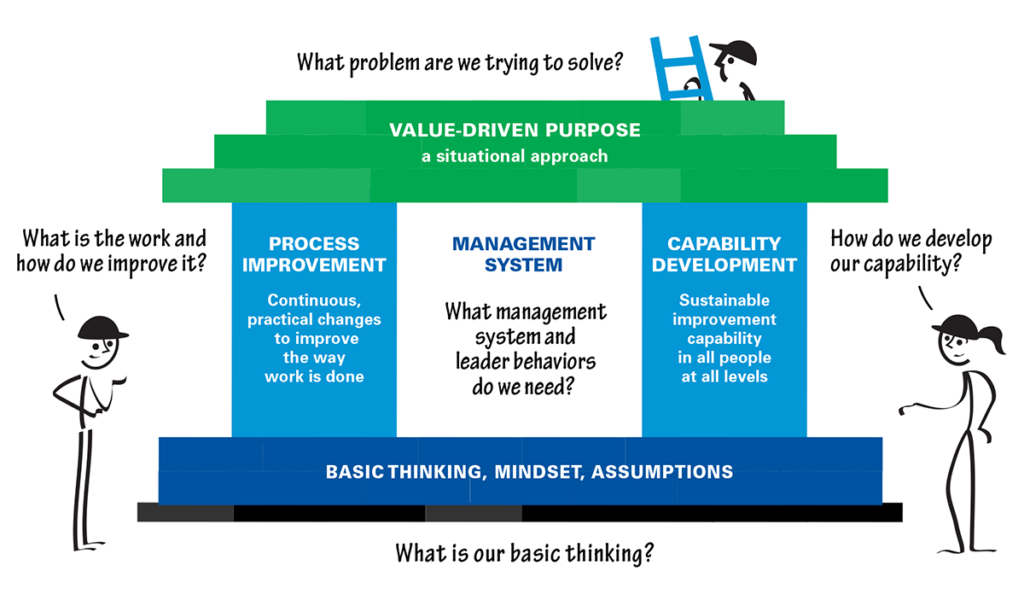
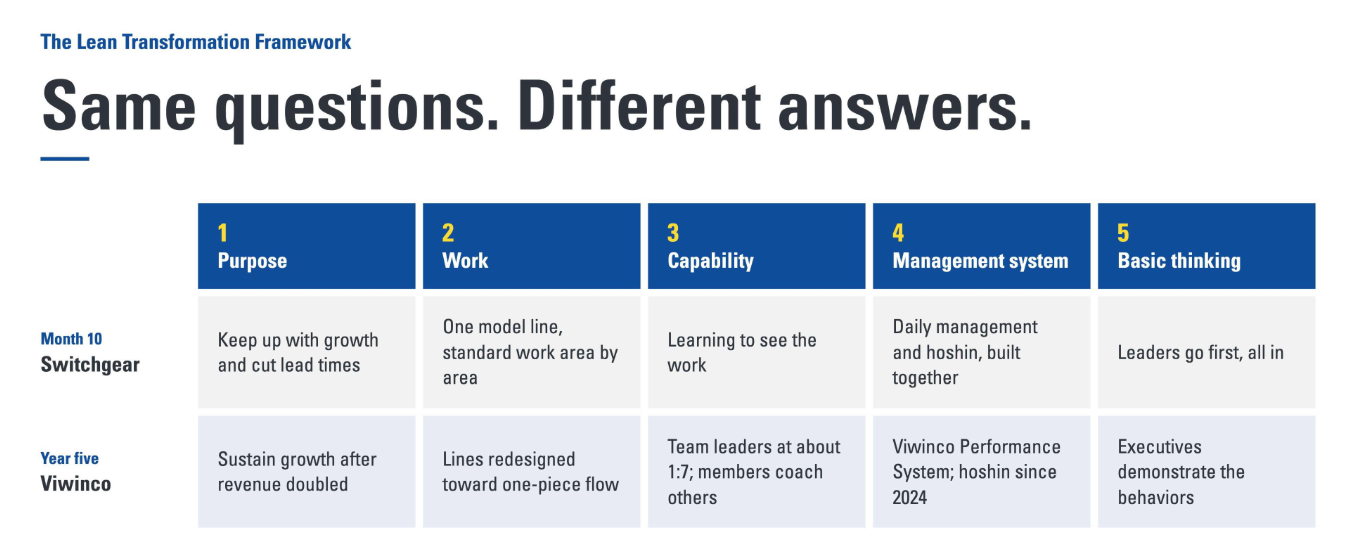
The two lean journeys can be studied through the lens of the Lean Transformation Framework (LTF), which poses five questions:
- What is the value-driven purpose or the problem to solve?
- What is the work to be done (to solve the problem)?
- What capabilities are required (to do the work to solve the problem)?
- What management system—operating system and leadership behaviors—is required?
- What basic thinking, including mindsets and assumptions, is required by the organization as a purpose-driven socio-technical system?
As the two stories demonstrate, the questions of the LTF stay the same throughout a lean journey. What changes as the organization matures are the answers.

When Growth Outruns the Way You Manage
Rens has been with Switchgear since 2012 and took over leadership in 2023. He was familiar with lean through the work of his father, who was a lean practitioner in the 1990s. “I’ve always been a believer that lean is the best way to do things,” said Rens. The company was “using a few lean tools” to improve, such as value-stream mapping, but it was doing so within a traditional management structure. Rens said production was “very chaotic, a lot of firefighting, not a lot of root-cause problem solving.”
“One of our sales reps told me, ‘We have industry-worst lead times,’ which is not a nice thing to hear,” said Rens. With lead times driven largely by engineering, Rens wanted to develop the capabilities of people to better support growth and customers, and he saw the need for a lean management system to structure and manage lean improvements. The leadership team entered LEI’s Lean Management Program in February 2026, and on-site coaching with Gaudet began in March.
Viwinco, a few years earlier, lacked a true lean foundation and business practices to sustain growth. “I thought we needed to advance the structure inside operations,” said Duncan. In August 2021, the company began working with LEI.
At both organizations, Gaudet convinced the executives to develop lean mindsets and behaviors as an executive team. “She said, ‘If you guys really want to ever sustain this, you have to start with yourselves and you have to develop some lean technical chops as an executive team,’” recalled Rens. “And so my team was also engaged with Karen from the first visit on site. … We were all going through it together, which really, really helped.” Rens said there were a few skeptics who wondered how lean could work in an engineered-to-order environment, but “we were hungry for a way to improve our current situation.” At Viwinco, most of the executive team, including the heads of HR, IT, and finance, took part in the first workshops with LEI. “Making sure that at the executive level, you’re really getting them exposed to the concept so that they can also start kind of demonstrating the behaviors that we need,” said Duncan in a 2025 podcast for The Management Brief.
Viwinco’s business isn’t exactly a typical lean environment, either. Nearly all of its windows and doors are custom, and most are delivered within a week with no finished-goods inventory. Duncan doesn’t see that as an obstacle. To him, it is “a very lean business model… all custom, but it’s high volume.” Making only what customers order, with no stock, is close to what lean aims to achieve.
Same Model Line, Different Answers
Switchgear created a model line to experiment, standardize work, and develop its lean management system. It chose its highest-volume product for the line: “nine a month, and they’re all the same,” said Rens. Each unit requires about 1,500 hours of wiring, and the line runs to a takt time of roughly 44 hours. On the line, the team is writing standard work packages area by area, starting with what repeats on every job, regardless of the engineering. “The way you crimp a wire can always be the same,” Rens said. He also sees the model line as a way to “cross-pollinate” lean to other areas of the plant, with supervisors and staff from throughout the facility participating in model-line improvement activities.
“I really think the biggest help that we’re going to get from the model line work is the capabilities that people are developing to observe work, to document work elements, to be able to look at steps and say, ‘Is that a difficult or hard piece of work to do?’” said Rens. “Being able to look at steps and categorize them as value-add or nonvalue-add, right? You can’t eliminate nonvalue-add work if you don’t know how to spot it.”
Learning to see the work has been humbling for Rens. During one of Gaudet’s first visits to Switchgear, they filmed an operator wiring a door. Asked whether anything about the job was difficult, Rens, who had been focusing on the operator’s hands, said, “No.” Gaudet then showed him a frame of the operator standing on her tiptoes to reach the panel, and she asked whether he thought that was hard to do for four to eight hours a day. “I was so hyperfocused on the hands, because that’s where the quote-unquote value-add work is happening, that I failed to notice that she needs a step stool,” he said.
In Viwinco’s first year with LEI, the lean work started by observing processes and applying lean improvements based on what the observation exercises revealed. This early approach convinced leadership to build its new 70,000-square-foot glass-processing facility around lean concepts. It also helped a lean organization structure begin to take shape and surfaced gaps in capabilities to manage the improvement process, ultimately leading to the development of a management system.
In 2025, nearly four years into the journey, Viwinco leadership realized there was only so much efficiency and capacity that individual improvements would offer and decided to totally redesign a line toward one-piece flow. Getting there meant connecting the processes and drastically reducing work-in-process (WIP) inventory. Kauffman recalled that a time study of the existing line revealed that more than 50% of process time was spent trying to find the next part in the WIP. The model line standardized WIP at six windows between processes (an 80% reduction). “That was a very major shift in thinking and major transformation for the team. And it was a rough road,” he said. The target is one piece between workstations.
The model line at Viwinco showed that one-piece flow was within reach, and it also established standardized work for team members, team leaders, supervisors, and managers. As at Switchgear, it became a platform for learning and development as the company redesigned other lines and standardized work and work roles. The model line also created a support structure around the work: one team leader for about every seven team members, and an andon system that summons a team leader to the line when a problem occurs. The approach also enabled model-line team members to learn how to coach others and prepared them for potential advancement to team leaders.
“For me, one of the biggest learning pieces of this was that it’s not just a set of tools; it’s not just a kaizen event or 5S or problem solving,” said Duncan. “That’s a huge piece of it, but the part that I learned is that fundamentally it’s about building the capability of people. We’ve got to be able to build the organizational capability of [the workforce] while utilizing them. And that’s very messy because you’re trying to implement things when you have capabilities that aren’t there yet.”
Less than a year into its lean transformation, Switchgear is using the model line to learn to see the work; five years in, Viwinco is building roles and structure around it.
Who Leads the Management System, and in What Order
Both Rens and Duncan held various roles in their companies before ascending to the top spot. They have been very hands-on during their companies’ lean transformations, and they see no way around that.
“I think I need to be very involved because what we’ve learned is that lean is the management system,” said Rens. “So if I am the President and Co-owner of the business and it’s my role to manage the business, then I should be an active participant in the management system. I’m leading our current hoshin kanri planning that we started at the end of September. I’m choosing to at least do it initially for my own learning.”
Rens said he is less involved in the daily management that occurs at the frontline but is keenly aware of what’s happening there. “My philosophy with the daily management was like, I’m not going to tell you how to do it. The only non-negotiable for me is that it has to be done.” Rens has learned this the hard way. Before engaging LEI, Switchgear had started to experiment with hoshin planning, only to discover that “hoshin without the other things like A3 capabilities and daily management, you only have one leg of the stool.”
Hoshin without the other things like A3 capabilities and daily management, you only have one leg of the stool.
Adam Rens, Co-owner and President, Switchgear Power Systems
Duncan has been hands-on since Viwinco began working with LEI, but hoshin kanri came later, once the company had a few years of frontline improvement under its belt. Before lean, Viwinco’s strategy was “like a 20-page Word document, built solely by me, maybe with some input of the executive team,” he said. The first attempt at hoshin, in 2024, exposed a gap. One objective was a big reduction in material waste, captured in what Duncan calls “a technically beautiful A3. … But then we handed it off to all the people in January that needed to do all the work. And that was totally unfair.” For 2025, the executive team built a five-year vision, narrowed it to three problems to solve, and tested the plan through horizontal and vertical catchball with team members from across the company before committing to targets.
Duncan believes that his role is to create the environment for lean and continuous improvement to succeed. The centerpiece of that effort was establishing the Viwinco Performance System. “We can do the work in a line, but if we’re going to advance the whole organization and we’re going to sustain, we need to have this concept of a management system,” he explained.
We can do the work in a line, but if we’re going to advance the whole organization and we’re going to sustain, we need to have this concept of a management system.
Mike Duncan, President and CEO, Viwinco
Seven months in, Switchgear began to build daily management and hoshin kanri at the same time, something Viwinco did in sequence. That carries a risk: as Rens learned from his first attempt, hoshin without daily management to carry the targets is only one leg of the stool. This time, though, the plan comes with A3 training and a “non-negotiable” daily management system behind it. Whether that is enough will show next year. If Duncan’s experience at Viwinco holds, the hoshin targets Switchgear hits in the coming year likely will be the ones its daily management supports most firmly.
Lean Outcomes
Switchgear used its model line to show that standard work packages can be applied to the many steps of its unique production environment. According to Rens, the line could now “produce more if we needed to in the same footprint.” Shorter lead times, he said, will depend on the engineering side, where everything is engineered to order and the company began applying lean product and process development about three months before the podcast.
Five years in, Viwinco’s results are more pronounced. On-time delivery has risen from 80% to 95%. Pointing to the business as a whole, Duncan said: “From a profitability standpoint, [we] make more money now in a month than we did in a year before.”
| LTF Question | Switchgear (month 10) | Viwinco (year 5) |
|---|---|---|
| Purpose/problem | Keep up with growth; “industry-worst lead times,” driven largely by engineering | Keep up with growth, then sustain it after revenue doubled to $100 million |
| Work | One model line on the highest-volume product: 44-hour takt, standard work packages area by area | A model line redesigned for one-piece flow; WIP reduced by 80%; second and third lines redesigned |
| Capability | Learning to see the work: observing, documenting work elements, spotting nonvalue-add | Team leaders to team member ratio at about 1:7, andon, shadowing, model-line members coaching others |
| Management system | Daily management required; hoshin started at the end of September 2026, led by Rens | Viwinco Performance System; hoshin since 2024, with a five-year vision and catchball |
| Basic thinking | “You have to be all in”; leaders go first | Executives engaged, aligned, understanding the rationale for lean, and willing to exhibit necessary behaviors to engage others |
The questions Switchgear is answering today are the ones Viwinco faced five years ago. What has changed at Viwinco are the answers: the problem has moved from keeping up with growth to sustaining it, and the work has moved from one line to the whole system that manages it.
For leaders looking to emulate the progress made at Viwinco and Switchgear, Duncan said a lean transformation has to be a nonstop progression and that leaders should expect issues and challenges along the way. “I think it’s just really messy, and you’ve got to have conviction to really keep pushing through, even when you don’t necessarily feel you can see tangible benefits right away.”
Similarly, Rens sees a lean management system as a complete overhaul of business practices, rather than just an add-on. He shared a few final words of advice: “You have to be all in, … and you just have to be comfortable not really being able to necessarily feel progress. You’re never going to be able to shine a light to the end of the journey. You just kind of got to be willing to put one step in front of the other.”
Mike Duncan and Zachary Kauffman will speak at the 2027 Lean Summit in Los Angeles on March 16–17.
2027 Lean Summit
The premier leadership conference shaping the future of lean management for every business.