Lean Enterprise Institute Logo
  • Contact Us
  • Newsletter Signup
  • Cart (0)
  • Account
  • Search
Lean Enterprise Institute Logo
  • Explore Lean
        • What is Lean?
        • The Lean Transformation Framework
        • A Brief History of Lean
        • Lexicon Terms
        • Topics to explore
          • Operations
          • Lean Product and Process Development
          • Administration & Support
          • Problem-Solving
          • Coaching
          • Executive Leadership
          • Line Management
  • The Lean Post
        • Subscribe to see exclusive content
          • Subscribe
        • Featured posts
          It’s the Productivity, Not the People

          Design Brief | Reinventing Product Development: People...

          The Jidoka Learning Cycle diagram showing five connected stages: Problem Detected, Andon Stop, Problem Solved, Embed Learning, and Improved System in a continuous loop

          Lean AI Journal | The Assembly Line...

          • See all Posts
  • Events & Courses
        • 2026 Lean Summit
          March 12-13
        • Forms and Templates
        • Featured learning
          • From Toyota to Tech: Wiring Organizations to Win

            November 17, 2025 | Online

          • Managing in Time with Daily Management

            January 09, 2026 | Coach-Led Online Course

          • Managing on Purpose with Hoshin Kanri

            January 20, 2026 | Coach-Led Online Course

          • The Lean Management Program

            February 06, 2026 | Coach-led Online Program

          • See all Events
  • Training & Consulting for Organizations​
        • Interested in exploring a partnership with us?
          • Schedule a Call
        • Getting Started with Lean Thinking and Practice
        • Leadership Development
        • Custom Training
        • Lean Enterprise Transformation​
        • Case Studies
  • Store
        • Book Ordering Information
        • Shopping Cart
        • Featured books
          It’s the Productivity, Not the People

          Daily Management to Execute Strategy: Solving problems and developing people every day

          Managing on Purpose Workbook

          Managing on Purpose

          • See all Books
  • About Us
        • Our people
          • Senior Advisors and Staff
          • Faculty
          • Board of Directors
        • Contact Us
        • Lean Global Network
        • Press Releases
        • In the News
        • Careers
        • About us

The Lean Post / Articles / It’s the Productivity, Not the People

It’s the Productivity, Not the People

Operations

It’s the Productivity, Not the People

By Craig Stritar

January 12, 2016

In one memorable lean project, Craig Stritar found himself on a large fish-processing vessel in the Bering Sea that was plagued by poor productivity levels. The supervisors insisted that inadequate staffing was the problem - Craig begged to differ. His transformation would require a specialized approach, in which he would not be able to use any lean terminology. Find out how he did it.

FacebookTweetLinkedInPrintComment

I thought I had missed the boat, so to speak, by not going fishing in Alaska after college. I had always wanted to give it a try, but it is a young man’s game and I had been a lean practitioner in both production and healthcare for nearly a decade. When I finally got my chance to fish, to my surprise, the experience resulted in me getting referred to a Bering Sea fishing company that had been plagued with poor production since converting from pollock fishing to trawling nearly five years earlier.

After getting over my seasickness and getting up to speed on my “other duties as assigned,” I was presented with a great opportunity to work with a newly promoted factory supervisor, a first mate who would eventually become the leading lean thinker on board, and a captain who supported increased involvement of the vessel leadership in the factory. Since many of the crewmembers were skeptical about our approach and had previously worked on a poorly run Japanese fishing vessel, we were careful not to use the words “lean” or “Toyota.”
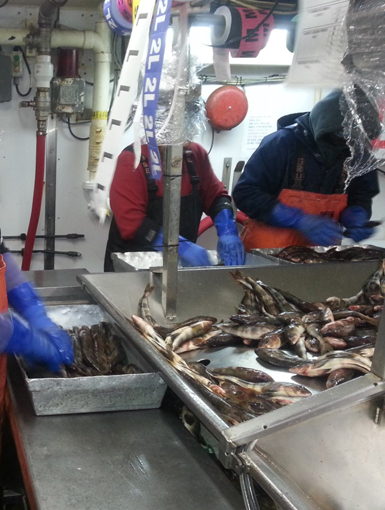
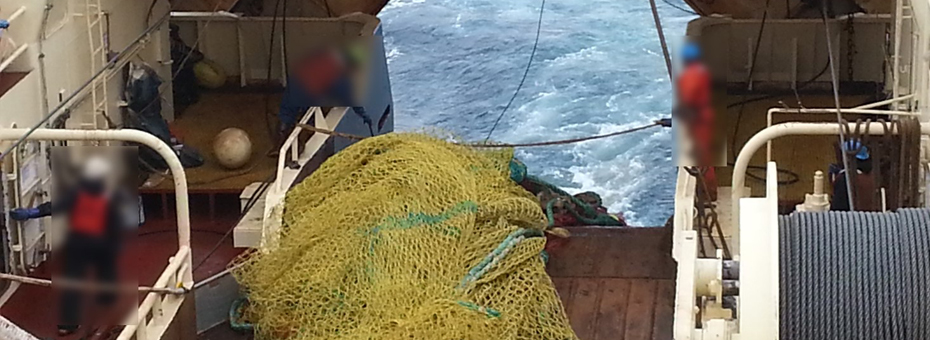
It’s the Productivity, Not the PeopleTo paint a simplified picture of the production process: a net with 30 to 40 tons of fish is hauled onto the deck and funneled down into the “live tank” at the start of the factory. Various stations sort the catch by species and size, remove the heads and guts, and arrange 20 kilograms of product in metal pans. The pans are then frozen over the course of several hours before being packaged and stored in the hold. Once 600 tons of finished product are on board, it is time to offload at Dutch Harbor and return to sea.

The factory supervisors had been complaining that the machines were too old, the number of crew insufficient, and the size of the fish too small to meet the 90 tons of finished product per day production target. One of the first questions we asked the new supervisor was “How do you know how many people you need?” After discovering that the number of people needed was calculated based on very old projections, we conducted time studies to see whether these projections had proven accurate.

Even prior to initiating focused improvement efforts, the act of conducting the time studies helped the supervisors learn how to level their production flow. Have you ever watched 5 year-olds play soccer, where the entire group chases the ball and the positions might as well not even be assigned? It is surprising how often factories are run in a similar fashion! This factory was no exception. Most of the crew would run the Head and Gut, or H&G, machines until a massive pile of work built up at “panning,” the next step in the process. Every ten or fifteen minutes, the “H&G” machines were shut down while the crew migrated to the panning stations. Ten or fifteen minutes later, they migrated back.

The supervisors realized that with the staff shuttling between stations four times an hour, it was difficult for them to determine the pace each station needed to run in order to meet demand (we did not call it “takt time”). They also calculated that each migration took about a minute, which led us to ask how much production would be gained simply by placing the correct number of people at the correct work stations. After recovering from the shock that the practice allowed the 24-hours-a-day operation to lose approximately an hour and a half of production, using the cycle time calculations, they placed the number of people needed at each step in the process to meet takt and virtually eliminated the need to “move people to the work.” 

There was another interesting benefit after factory leadership learned how to calculate takt and cycle times: it was the first time in five years they informed the head office in Seattle they had enough people! Furthermore, in addition to gaining an hour and a half of production by placing workers in the right locations, the oldest, most problematic H&G machine was now rarely used, and the less optimal overflow panning stations were similarly avoided. The result? Unexpected efficiency gains, all before we had begun engaging in systematic improvement efforts.

How does this slow introduction of lean tools compare to some of your journeys? Have you had more success with big kickoffs? I am interested to hear how others found success in introducing TPS into a culture after being told “It won’t work here.”

FacebookTweetLinkedInPrintComment

Written by:

Craig Stritar

About Craig Stritar

Continuous Improvement Manager, IDEX Health & Science

Since being introduced to lean over a decade ago, Craig Stritar has been working in industries ranging from healthcare to production and distribution; at one point even leaving the safety of land to introduce “lean at sea” on an Alaskan factory trawler. Like many other practitioners, for the past several years, Craig has focused almost exclusively on organizational cultural transformation through daily learning cycles (Toyota Kata and TWI). He is presently the Director of Operations Improvement at Meritus Health in western Maryland.

Leave a Comment Cancel reply

Your email address will not be published. Required fields are marked *

Related

"Webinar promotion banner for Lean Enterprise Institute. Title: 'Lean AI: A New Way to Learn, Practice, and Apply Lean Thinking.' Subheading: Free Webinar. Featured speakers: Art Smalley, President at Art of Lean, Inc.; John Shook, Senior Advisor, Lean Enterprise Institute; Tyson Heaton, Senior Director and Senior Coach, Lean Enterprise Institute. Blue background with speaker headshots and Lean Enterprise Institute logo.

Executive Leadership

Lean AI Journal | Join the Lean AI Webinar

Article by Tyson Heaton, John Shook and Art Smalley

Multi-level Visualization: Engage Everyone in Problem-Solving to Achieve Business Results

Operations

Multi-level Visualization: Engage Everyone in Problem-Solving to Achieve Business Results

Article by Michael Ballé

A digitized brain exploding into vectors and jumbled computer code.

Operations

A New Era of Jidoka: How ChatGPT Could Alter the Relationship between Machines, Humans, and their Minds

Article by Matthew Savas

Related books

Daily Management to Execute Strategy: Solving problems and developing people every day

Daily Management to Execute Strategy: Solving problems and developing people every day

by Robson Gouveia and José R. Ferro, PhD

The Power of Process book cover

The Power of Process – A Story of Innovative Lean Process Development

by Eric Ethington and Matt Zayko

Related events

April 14, 2026 | Morgantown, PA

Building a Lean Operating and Management System 

Learn more

April 16, 2026 | Morgantown, PA

Investing in Work(ers) Using Job Methods and Job Instruction

Learn more

Explore topics

Operations graphic icon Operations
Line Management graphic icon Line Management
Problem Solving graphic icon Problem Solving

Be the first to learn of new learning opportunities and the latest practical, actionable information. Subscribe to an LEI newsletter.

Subscribe

Join us on social

  • LinkedIn
  • Twitter
  • YouTube
  • Instagram
  • Facebook
  • Privacy Policy
  • Sitemap
  • LinkedIn
  • Twitter
  • YouTube
  • Instagram
  • Facebook

©Copyright 2000-2025 Lean Enterprise Institute, Inc. All rights reserved.
Lean Enterprise Institute, the leaper image, and stick figure are registered trademarks of Lean Enterprise Institute, Inc.

This website uses cookies to improve your experience. We'll assume you're ok with this, but you can opt-out if you wish. Learn More. ACCEPT
Privacy & Cookies Policy

Privacy Overview

This website uses cookies to improve your experience while you navigate through the website. Out of these cookies, the cookies that are categorized as necessary are stored on your browser as they are essential for the working of basic functionalities of the website. We also use third-party cookies that help us analyze and understand how you use this website. These cookies will be stored in your browser only with your consent. You also have the option to opt-out of these cookies. But opting out of some of these cookies may have an effect on your browsing experience.
Necessary
Always Enabled
Necessary cookies are absolutely essential for the website to function properly. This category only includes cookies that ensures basic functionalities and security features of the website. These cookies do not store any personal information.
Non-necessary
Any cookies that may not be particularly necessary for the website to function and is used specifically to collect user personal data via analytics, ads, other embedded contents are termed as non-necessary cookies. It is mandatory to procure user consent prior to running these cookies on your website.
SAVE & ACCEPT