In this four-part series, LEI parses the lean improvements at Viwinco through a lens of the Lean Transformation Framework (LTF) questions.
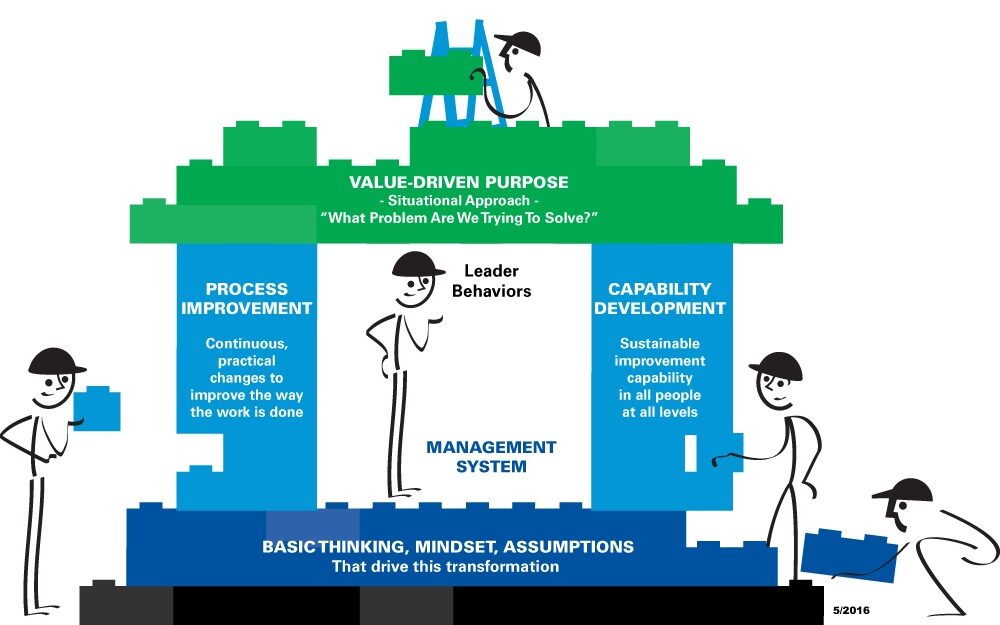
All of the LTF questions need to be addressed; if applied a la carte, a transformation is likely to fail. For example, we don’t believe you can only improve processes without also developing the capabilities of those working in the processes. Or you cannot apply technical tools and develop a management system without instilling the mindset, behaviors, and willingness in management and frontline team members to utilize the tools and system. The full Viwinco case study shows how all these LTF components successfully come together.
Lean transformations are challenging, and each one is unique. Breaking the Viwinco case study down over the course of weeks gives you an opportunity to digest and reflect on each of the LTF components and consider their application in your organization.
This initial article examines how Viwinco addressed the first LTF question — What is the value-driven purpose or the problem to solve? — and got moving on their transformation journey.
About Viwinco
Viwinco is a family-owned business, founded by Jack Barnes Jr. in 1982 in Morgantown, Pennsylvania; David Barnes is the second-generation owner and Chairman of the Board. The company has 430 employees and revenues of $115 million. Operations exist at its one location across three buildings, including four glass production lines and seven window fabrication and assembly lines. A fleet of 20 delivery vehicles make milk runs north to the far New York border, south to the Florida panhandle, and west to St. Louis.
Viwinco is a high-volume manufacturer of custom products (windows and doors). Its fast-paced business model has it producing and delivering approximately 75% of its products on a one-week lead time. The company has billions of possible product configurations that are custom made-to-order. On any day, hundreds of unique products are produced. Viwinco holds no finished goods inventory, with products loaded into truck trailers during the day and out on milk runs within 24 hours of being produced.
From 2018 to 2022, the company was in an enviable growth mode, doubling revenue to $100 million. Yet despite what appeared to be a dynamic, lean business model focused on fast delivery of unique goods to customers and some procedures that looked to be lean, company practices and processes were not technically “lean.”
In 2022, the company was still growing rapidly and needed more capacity. The opportunity to grow demand further would require an operations transformation. Existing processes were not sustainable and scalable, resulting in inconsistent performance to the customer. Frequently frontline staff would try to solve problems they encountered on their own to keep production running, and there wasn’t a management structure or process in place to escalate problems that could not be solved at the line.
“A lot of it was pushing product through the factory, a lot of firefighting, heroic efforts,” says Mike Duncan, President and CEO. “I thought we needed to advance the structure inside operations, and … bring up the business with lean thinking, lean processes to really support that business model in a sustainable way, in a scalable way.”
Duncan and leadership began the application of lean in 2021. An important first step was bringing all leadership beyond operations — Finance, IT, HR, etc. — on board from the start with lean thinking. “Instead of trying to do it in a silo, I think it’s very important to try and expose as many people as possible,” says Duncan.
In August 2021, Viwinco began collaborating with the Lean Enterprise Institute (LEI). As a co-learning partner with organizations, LEI works “hands-on,” with both parties experiencing learning by doing.
“[Viwinco] had been quite successful up to that period of time, or they wouldn’t have had the growth that they were experiencing,” says Karen Gaudet, LEI Senior Coach. “It’s not like the construction industry saw some major macroeconomic thrust during this period of time. They were certainly performing well in their customers’ eye, and they were getting demand.” They would do everything within their power to maintain rapid lead times; however, their efforts were based on a push system and large batches.
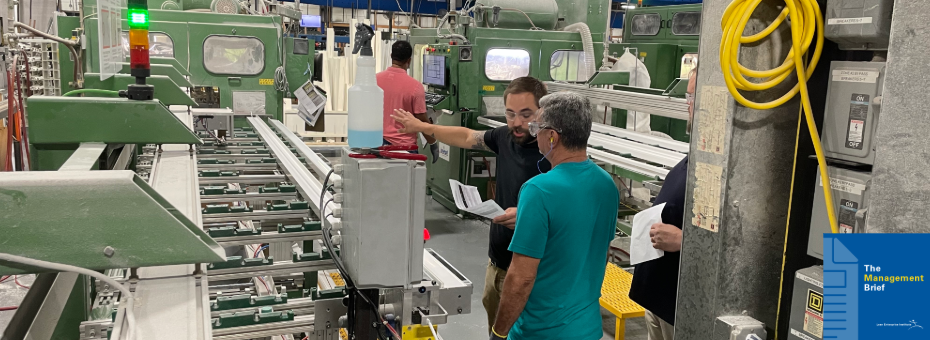
The initial focus with LEI was on a production line that had the most repeatable, cyclical processes (line No. 1). A workshop helped staff learn the fundamental steps of how to observe work, document the process, and follow through using the 3C framework. 3C is for work observation and defines the characteristic (burden, uneven, and/or hard), content (value-add, incidental, or waste), and category (abnormal, periodic, or cyclical) of each element of the work.1
“We did a full observation of the entire line, which netted out, from an outcome perspective, a visual mapping of how line No. 1 operated, which exposed some of the key problems and challenges within how that line was operating,” says Gaudet. Specific challenges were with the integration of saws used to cut vinyl frames with downstream manual assembly processes and hardware stations, as well as quality issues with vinyl cuts.
Duncan says the fundamental observation work began to show managers and staff waste in the operation and led them to develop their problem solving to eliminate it; people were willing to learn about lean and try new things, in part because they had begun to see all the waste in the processes. Three improvement projects were undertaken (saws, workstations, and quality) and acquainted frontline teams with lean foundations of standardized work, 5S, and timed cycle times in order to identify bottlenecks, remove waste, level work on the line, and improve flow to match takt time. They also revised frontline roles to better support value-creating work and created the team leader role.
“Those experiences were to try to help realize a business improvement in the process, but more than that it was about giving them a direct experience of what it means when we talk about a lean transformation,” says Gaudet. “You have a business problem that lies somewhere within the workflow. Work observation helps the leaders break down the problem and identify the point of occurrence.” When they learn to see and begin to understand the work, people become engaged in the process of improving the work method. This approach makes it approachable vs. simply based on theory or abstract.
The three projects provided a strong experience for the teams, adds Gaudet. They could clearly see the opportunities, the challenges they were having, and the next steps they would need to take. The initial lean work on the line also was surfacing the need for a system to sustain improvements.
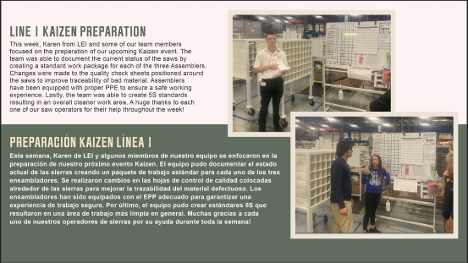
As the initial teams made improvements to line No. 1, leadership shared the achievements with the rest of the company. A “Wins of the Week” newsletter was eventually created to spotlight team members and explain, in English and Spanish, the achievements, such as lead time or quality improvement. They also created a recognition program (See It, Fix It) that recognized the number of improvements employees made in a certain period of time. “They did a nice job of trying to really engage the frontline on feeling good about identifying problems, being recognized for participating in solving those problems, and helping with the transformation,” says Gaudet.
Next Week
Part 2: From Lean Fixes to Lean Redesign
- “Developing a Respectful but Critical Eye to Assess Work Processes at the Gemba,” Turner presentation, Lean Enterprise Institute, 2023. ↩︎
Building a Lean Operating and Management System
Gain the in-depth understanding of lean principles, thinking, and practices.