In this four-part series, LEI parses the lean improvements at Viwinco through a lens of the Lean Transformation Framework (LTF) questions.
All of the LTF questions need to be addressed to ensure a meaningful transformation; if applied a la carte, success is unlikely. The full Viwinco case study shows how the LTF components came together and resulted in dramatic changes.
This second article examines how Viwinco (a high-volume manufacturer of custom windows and doors, with billions of possible product configurations, and the majority of goods delivered on a one-week lead time) addressed the second LTF question — What is the work to be done (to solve the problem)? — and began to see substantial improvements. Addressing the second dimension also surfaced the need for capabilities and management systems going forward.
As with most lean transformations, Viwinco came to realize that incremental improvements to line No. 1 would only result in so much efficiency and capacity. The decision was made to totally redesign the line in 2025 for one-piece flow. Unlike one-piece flow in other manufacturing environments that run thousands of identical products, Viwinco’s offering of 100% custom products means its one-piece flow would be running windows of various sizes and options one after the other, not the same window over and over.
Every little incremental improvement that gets made — it doesn’t matter where it happens — creates a domino effect for the next improvement. It starts to pull the next improvement that’s required by the next process step.
— Karen Gaudet, LEI Senior Coach
Changes to line No. 1 were substantial, and included investments in specially designed vinyl-cutting and welding equipment to accommodate one-piece flow, which dramatically reduced work-in-process (WIP) inventory throughout the line, including at the saws. In the line’s original configuration, the amount of WIP between workstations was “tremendous,” says Zachary Kauffman, Director of Continuous Improvement.
More than 40 pieces of WIP existed throughout all stations on the line — welders, corner cleaners, hardware stations, etc. “I remember our very first time study and doing the 3C process. We looked at the process time and the waste, and actually found the majority of their time, more than 50% of their process time, was trying to find the next part in the WIP,” says Kauffman. The finding led to standardizing WIP, reducing it to six windows of inventory between each process (an 80% reduction). “That was a very major shift in thinking and major transformation for the team. And it was a rough road. Since then, they got used to working with six.” And now the line redesign is working toward one piece of inventory between stations.
Standardized work has been applied to the jobs at each workstation and has been developed with an eye toward improved safety as well as efficiency. “It’s hard work, but one thing we’re really focusing on right now is safety, making sure we got the ergonomics right in each work center,” says Andrew Buczewski, Director of Operations. “We’ve historically run a push system here, like ‘Let’s go, let’s go, let’s go,’ whereas now we’re managing flow more, so the difficulty of the work is definitely being reduced by installing these lines.”
Buczewski says the redesign has given team members room to work and under more comfortable conditions, with new air conditioning, ventilation, and painting. “A lot of companies don’t focus on employee well-being when they’re doing capital projects. Where’s my money?… It’s not just the lean side of the transformation in terms of technically speaking, but it’s also the people side of the transformation as well, making sure the employees are comfortable, they have what they need, and they’re in a place where they feel good and they’re happy to be at every day.”
Other organizational changes, in addition to the technical, have included standardized work applied to team leader and supervisor roles. A team leader oversees a team at a process on the line, and supervisors oversee the line. “One of the things that we recognized very early on as we’ve been on this lean journey and making changes to how we do things is getting that support structure in place: the manager, supervisor, team leader in place to support the value-added work,” says Kauffman.

The sequence of work in each station is specified, and, by following the standardized work, team members immediately know if they’ve encountered a problem of quality, time, or with a tool. When that occurs, they know to ask for team leader support by triggering an andon light at their workstation. The team leader then should take care of the problem and enable the team member to get back to performing their standardized work.
Kauffman says a big shift for frontline team members — who are extremely hardworking, want to do a good job, and hit their targets — is how they address problems. Previously, team members would work through a problem on their own, which is inconsistent with standardized work and hides the real problem. “The reason that’s important is, in the old method, we didn’t really know what the problems were because they were happening under the radar. So we want to be able to highlight those so it’s very clear on what’s impacting our performance so we can get the right support to resolve that issue. That’s been the biggest shift, and we’re getting there.”
Karen Gaudet, LEI Senior Coach who has been working with Viwinco, says the challenge initially for team leaders was to not get pulled into operational work beyond responding to the call for help; she and the continuous improvement (CI) group have been helping team leaders know when and when not to engage in operational work. They also are developing a playbook for line supervisors for how to address short-term volume changes: higher volume (move labor from another line) or lower volume (use as an opportunity for cross-training or improvement projects). The playbook also will instruct supervisors how to revise standard work for line processes based on the team-member volume changes.
“We’re trying to take the complexity out of it,” says Gaudet. “So all she [the supervisor] needs to worry about is, these are my inputs. This is the play I’m going to select. This is my condition. This is how I’m going to respond.”
Another change at workstations has been to establish a replenishment system for material deliveries to the line, such as accessories and hardware. Team members previously would leave their stations to replenish materials on their own. They now have bins of accessories on hand, and when one bin is emptied it’s dropped into a chute that feeds down to the back side of the line. The materials team has multiple 20-minute routes during which they visually identify and pick up empty bins, each with a part number on it, ensuring materials stay stocked at the workstations.
Visual management also displays production targets for the day for each line. Monitors show targets by hour based on customer demand and takt time: the percentage of schedule completed for the day, actual quantity of units since the start of the shift, and hourly performance ratio (running to takt time = 100%). Team leaders and supervisors review conditions by hour and assess factors affecting hourly performance, number of units affected per factor, and how to prevent recurrence of problems that may have prevented a line from achieving its performance (red vs. green). The problems that occur in the work are documented by hour and addressed within the tiered management huddles as needed.
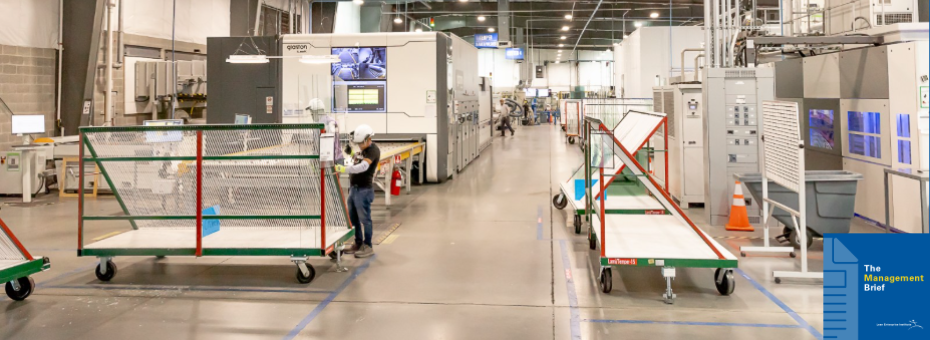
Preparation of carts with finished goods also has benefitted from visual management. Carts are organized by color code for the day of delivery, and a system-generated label specifies the milk run that will get them to customers; there are approximately 75 milk runs per week from the location. Previously, finished goods were carted off the line as a mix of dates and runs, making the loading department find and reorganize products, which would occasionally lead to a missed delivery.

“We did an improvement activity where it’s one route per cart, period, to force that standard so this can operate at a higher level of on-time and in-full performance,” says Gaudet. “That has caused additional learning capability needed for the line and the people at the end of the line. Every little incremental improvement that gets made — it doesn’t matter where it happens — creates a domino effect for the next improvement. It starts to pull the next improvement that’s required by the next process step.”
The reconfigured line No. 1 has served as a model to redesign other production lines at Viwinco and also as a training platform for team members from other lines to get up to speed on one-piece flow and lean tools and practices.
Lean beyond Model Line No. 1
As Viwinco leadership became familiar with lean concepts and saw early returns from line No. 1, the company was breaking ground on a new 70,000-square-foot glass-processing facility across the street from its main plant. The decision was made to apply lean concepts to the plant’s design, including flow and standardized work, as well as new technologies and processes. “We really put a lot of effort and focus on that building to make sure that when we’re launching that it had some of the principles that we want,” says Mike Duncan, Viwinco President and CEO.
The new facility has taken Viwinco from one glass cutter that fed four lines (and was a bottleneck as demand grew) to four glass cutters that keep pace with the rising demand from the window and door lines. The plant receives large same-size panes of glass from its supplier in different thicknesses and types, which are then cut to sizes specific to customer orders followed by tempering, laminating, and assembling insulated glass units for windows and doors.
The new operation is far more technology-driven and has a much simpler linear flow compared to the complex material movements of the old glass processes. In addition to a more streamlined material flow, the new facility has better product consistency (a 90% reduction in seal failures, which had been the top customer defect), higher capacity, and faster overall throughput. Automation also has reduced manual work, such as feeding glass into the tempering furnace by hand. Duncan considers the plant to be as impressive as any glass-processing facility in the industry.

Viwinco’s greenfield glass-processing plant
The plant’s engineering and technology focus has enabled more rigorous problem solving: Data from the plant’s glass-cutting system is reviewed each Friday, looking at trends and remakes that may have occurred, and Pareto analysis is the foundation for a structured problem-solving process. The glass and vinyl shop leaders review metrics posted at a main KPI board on Wednesdays as part of Viwinco’s management system, during which problem-solving owners report out on progress made since the Friday review.
In some instances, artificial intelligence (AI) has been used to identify and diagnose complex, materials-science problems occurring within machines. The AI work was led by Buczewski, who at the time was the Glass Shop Value-Stream Manager, with assistance from Tyson Heaton, LEI Executive Director Lean Tech/AI.1 Based on that work, Buczewski has been growing AI capabilities among other Viwinco staff.
Moving glass operations from the main Viwinco building opened up the opportunity to redesign additional vinyl production lines, learning from line No. 1 improvements. Two of those lines have higher volumes than line No. 1. In June, redesign of the first of those lines (line No. 2) was underway, with completion of both lines expected by September. The redesign includes a $12 million equipment investment to support one-piece flow.
“We just piloted our first true one-piece flow line, which is kind of blowing people’s minds a little bit, and our next two lines are in that image,” says Duncan. “That’s something we’re really pushing, this idea of having one-window flow vs. a lot of WIP in the process. That’s a huge culture shift because the margin for error gets even smaller. When you have a problem, that problem is screaming loud, right? So we’re continuing to push that culture on the support functions because we don’t have WIP to continue production if that machine goes down. That’s like this huge change that we’re undertaking as part of the main building transformation.”
An added challenge for the transformation is that the lines are being redesigned while still in operation. That’s required maintenance to reconfigure lines, and teams to build safety stock on weekends to ensure customer delivery is not affected as a line ramps up. Upfront work and planning are helping to ensure a smooth startup, and leadership has run frequent simulations to make sure cycle times are correct and within takt time and to identify any potential wastes. Buczewski says that 40–50% of Viwinco’s volume on any given day goes through line No. 2. “We’ve got to nail that out of the gate.”

“We’re doing all of this without any impact to the customer,” says Kauffman. “We are able to start up new lines, move people from one line to another without impacting the customer. So we’re really trying to keep this customer-neutral. The only impact to them is more higher-quality windows.”
In June, team members from line No. 2 started shadowing the work of line No. 1 team members, after which they’ll work on that line alongside engineering and the continuous improvement (CI) staff. Viwinco is following a four-step training method, similar to Training Within Industry methods, to build the capability of the team on the new process. This approach also enables line No. 1 team members to learn how to coach others and prepare them for potential advancement to team leader.
“They learn the skill technically, but they’re also learning socially how to actually train somebody so that they can be productive very quickly on the production line vs. just watch video for two months and then you can maybe do it,” explains Gaudet. “It’s really changing their behavior around how they develop people’s training.”
Next Week
Part 3: Building Workforce Capabilities
Want a partner beside you on your lean journey?
Viwinco’s progress is unfolding through a co-learning partnership with LEI — coaching where the work happens, with the lessons shared back to the community. Advance your transformation and help shape what everyone learns next.
Building a Lean Operating and Management System
Gain the in-depth understanding of lean principles, thinking, and practices.