Lean Enterprise Institute Logo
  • Contact Us
  • Newsletter Signup
  • Cart (0)
  • Account
  • Search
Lean Enterprise Institute Logo
  • Explore Lean
        • What is Lean?
        • The Lean Transformation Framework
        • A Brief History of Lean
        • Lexicon Terms
        • Topics to explore
          • Operations
          • Lean Product and Process Development
          • Administration & Support
          • Problem-Solving
          • Coaching
          • Executive Leadership
          • Line Management
  • The Lean Post
        • Subscribe to see exclusive content
          • Subscribe
        • Featured posts
          A dark software team room or open office, with a single wall monitor or andon light glowing Orange while the people nearby keep working, heads down. The light is plainly visible and plainly unanswered.

          You Can’t Improve What You Don’t Commit...

          17 Principles for Chief Engineers 

          Toyota Veteran Naoto Kitagawa’s 17 Principles for...

          • See all Posts
  • Events & Courses
        • 2027 Lean Summit
          March 16-17
        • Forms and Templates
        • Featured learning
          • InBox Lean Office Kaizen Simulation 

            October 28, 2026 | Rochester, MI

          • Managing on Purpose with Hoshin Kanri

            November 06, 2026 | Coach-Led Online Course

          • Lean Leadership Learning Tour

            November 09, 2026 | Kentucky

          • 2026 Lean Global Connection

            November 12, 2026

          • See all Events
  • Consulting & Training for Organizations​
        • Interested in exploring a partnership with us?
          • Schedule a Call
        • Getting Started with LEI
        • Enterprise Workshops and Training
        • Leadership Development
        • Lean Product and Process Development
        • Lean Enterprise Transformation​
        • Case Studies
  • LeanTech
  • Store
        • Book Ordering Information
        • Shopping Cart
        • Featured books

          The Work of a Chief Engineer: Inside Toyota’s Revolutionary Product Development System

          Daily Management to Execute Strategy: Solving problems and developing people every day

          • See all Books
  • About Us
        • Our people
          • Senior Advisors and Staff
          • Faculty
          • Board of Directors
        • Contact Us
        • Lean Global Network
        • Press Releases
        • In the News
        • Careers
        • About us

The Lean Post / Articles / From 40 Hours to 30 Minutes: How AI Will Remake the Shopfloor and Empower Workers 

40 hours 30 mins-2-lean post

Operations

From 40 Hours to 30 Minutes: How AI Will Remake the Shopfloor and Empower Workers 

By Matthew Savas

September 16, 2026

An engineer spent 40 hours on a time study. AI ran the same analysis in 30 minutes for $4 at 79% accuracy. The bottleneck to shop-floor tools is now you.

FacebookTweetLinkedInPrintComment

A month ago, I spoke with an engineer who spent 40 hours drafting a meticulous time study of a 20-hour custom fabrication job. He painstakingly analyzed 18 timelapse videos, at times scrubbing frame by frame, to mark each work element, bit of waste, and their durations. In total, he recorded nearly 1,000 rows in Excel detailing how the operator spent his time. 

But after 40 hours of all this work, the operator’s job hadn’t changed at all. 

The 40-hour analysis was a requisite, gruesome hill to climb to simply see the job and begin to think about where it could be improved. 

Following a talk I gave about AI at the Lean Enterprise Australia Summit, the company’s operations leader invited me to conduct an experiment to find out if AI could speed up this work. 

The answer was decidedly “Yes.” 

A combination of Claude, Gemini, and Codex executed the same study in 30 minutes for $4 and achieved median accuracy of 79% across the 18 videos—peaking at 90% in three of the videos—benchmarked against the engineer’s time study. 

Failures were caused by a camera angle that did not capture the entire work area, obstructed hands, and difficulty identifying some tools. The team quickly devised several countermeasures to address these problems in preparation for a second experiment. 

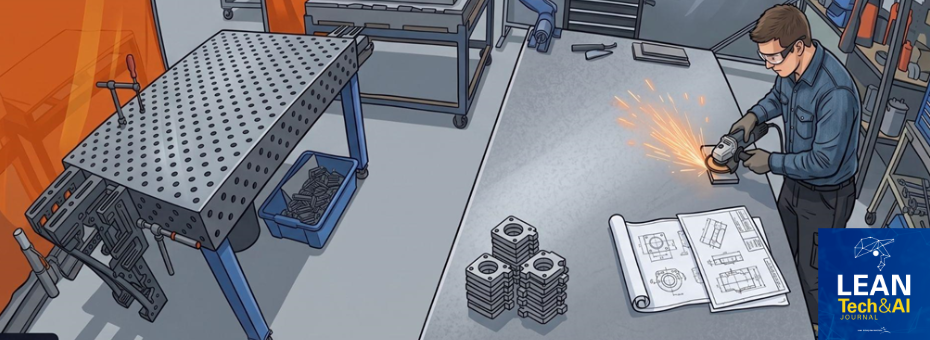
The AI did not just execute the analysis. With a bit of prompting, Opus 5 built an application displaying it that looks better than most enterprise SaaS. The image below is a recreation of the application using an illustration to disguise the company. Anyone could learn to use it with a few minutes of training. 

From 40 Hours to 30 Minutes: How AI Will Remake the Shopfloor and Empower Workers 

Had the engineer had this tool, he could have spent those 40 hours working alongside the operator to improve a job they could see together. 

A massive Excel spreadsheet is hardly an inviting way to engage someone. It’s intimidating, clumsy, and doesn’t even display work because the video is not in the sheet. If the engineer wants to show the operator how he spent nine minutes searching for a tool, he has to match row 538’s timestamp to one of 18 videos, then scrub to the correct time. Ironically, the 40-hour time study begets the waste of using the time study! 

More importantly, with some extended training, the engineer and even an operator could learn to build this tool themselves. The latest AI models—Opus 5, Fable, and Sol—are so capable that the bottleneck to building sophisticated tools is now you.  

Imagine an engineer working alongside an operator to build bespoke tools that solve precisely their problems: no expensive third-party vendors that cost tens of thousands of dollars, painful procurement, endless meetings designing the final system, a deployment that’s buggy and not what you expected, and, finally, a system that becomes digital wallpaper that users endlessly work around with shadow Excel sheets.  

A small team of people close to the work can build a working prototype in hours and continuously iterate their own solutions.  

Is an operator more likely to use a tool he designed himself or one IT ships to him? How many times can a company afford to assign a skilled engineer to a 40-hour time study? How many skilled engineers would it take to analyze the entire shop? 

Three effects will enable much more rapid improvement cycles:  

  1. AI can scale analysis across an entire floor and work continuously, providing immediate feedback to the whole team. 
  1. Engineers are freed from monotonous, time-consuming studies so they can focus their effort on improving the condition on the floor. 
  1. Operators participate in the system’s design so they are much more willing to use it. 

Now, there is the risk of management using these tools for mass surveillance rather than mass empowerment. Leadership should establish principles governing their use and model them. The lean mantra “Go see, ask why, show respect” will be more important than ever in the age of AI, as management can deploy legions of bots observing every second of every working inch of their facilities. Just see the recent article by Tyson Heaton, LEI Executive Director of LeanTech/AI, about how Meta is capturing employee keystrokes. Still, the opportunities outweigh the risks. Leaders who create the environment for bottom-up solutions will not just see tremendous business results but leaps in engagement. 

Leaders who create the environment for bottom-up solutions will not just see tremendous business results but leaps in engagement.

Enterprise software and MRP systems aren’t going anywhere yet. But new types of software, built by non-technical teams, will emerge and transform how work gets done. It will eliminate drudgery and share performance feedback so teams can rapidly improve. Because the people doing the work will build these systems, their utility will skyrocket. 

The days of creating the thousand-row Excel sheet are coming to a close, replaced by innovative solutions designed on the floor by the floor. 

Develop the skill, don’t rent it.

Lean AI Basics gives your practitioners a repeatable framework for putting AI to work in lean, taught live by Art Smalley. Two sessions, online. See dates and register.

FacebookTweetLinkedInPrintComment

Written by:

Matthew Savas

About Matthew Savas

Matt Savas is the founder of Kaizumi, an AI-powered lean training platform. Prior to Kaizumi, Matt worked at the Lean Enterprise Institute and Lean Global Network for over a decade.  

Leave a Comment Cancel reply

Your email address will not be published. Required fields are marked *

Related

viwinco greenfield site

Operations

The Lean Transformation at Viwinco, Part 2: From Lean Fixes to Lean Redesign   

Article by George Taninecz

"Webinar promotion banner for Lean Enterprise Institute. Title: 'Lean AI: A New Way to Learn, Practice, and Apply Lean Thinking.' Subheading: Free Webinar. Featured speakers: Art Smalley, President at Art of Lean, Inc.; John Shook, Senior Advisor, Lean Enterprise Institute; Tyson Heaton, Senior Director and Senior Coach, Lean Enterprise Institute. Blue background with speaker headshots and Lean Enterprise Institute logo.

Executive Leadership

Lean AI Journal | Join the Lean AI Webinar

Article by Tyson Heaton, John Shook and Art Smalley

Multi-level Visualization: Engage Everyone in Problem-Solving to Achieve Business Results

Operations

Multi-level Visualization: Engage Everyone in Problem-Solving to Achieve Business Results

Article by Michael Ballé

Related books

Upgrade to Hospitality Excellence

Upgrade to Hospitality Excellence

by Oriol Cuatrecasas, Cristina Fontcuberta, Lalis Fontcuberta and Roberto Priolo

Daily Management to Execute Strategy: Solving problems and developing people every day

Daily Management to Execute Strategy: Solving problems and developing people every day

by Robson Gouveia and José R. Ferro, PhD

Related events

October 28, 2026 | Rochester, MI

InBox Lean Office Kaizen Simulation 

Learn more

November 12, 2026

2026 Lean Global Connection

Learn more

Explore topics

Operations graphic icon Operations
Problem Solving graphic icon Problem Solving
  • Privacy Policy
  • Sitemap
  • LinkedIn
  • Twitter
  • YouTube
  • Instagram
  • Facebook

©Copyright 2000-2026 Lean Enterprise Institute, Inc. All rights reserved.
Lean Enterprise Institute, the leaper image, and stick figure are registered trademarks of Lean Enterprise Institute, Inc.

This website uses cookies to improve your experience. We'll assume you're ok with this, but you can opt-out if you wish. Learn More. ACCEPT
Privacy & Cookies Policy

Privacy Overview

This website uses cookies to improve your experience while you navigate through the website. Out of these cookies, the cookies that are categorized as necessary are stored on your browser as they are essential for the working of basic functionalities of the website. We also use third-party cookies that help us analyze and understand how you use this website. These cookies will be stored in your browser only with your consent. You also have the option to opt-out of these cookies. But opting out of some of these cookies may have an effect on your browsing experience.
Necessary
Always Enabled
Necessary cookies are absolutely essential for the website to function properly. This category only includes cookies that ensures basic functionalities and security features of the website. These cookies do not store any personal information.
Non-necessary
Any cookies that may not be particularly necessary for the website to function and is used specifically to collect user personal data via analytics, ads, other embedded contents are termed as non-necessary cookies. It is mandatory to procure user consent prior to running these cookies on your website.
SAVE & ACCEPT