Lean Enterprise Institute Logo
  • Contact Us
  • Newsletter Signup
  • Cart (0)
  • Account
  • Search
Lean Enterprise Institute Logo
  • Explore Lean
        • What is Lean?
        • The Lean Transformation Framework
        • A Brief History of Lean
        • Lexicon Terms
        • Topics to explore
          • Operations
          • Lean Product and Process Development
          • Administration & Support
          • Problem-Solving
          • Coaching
          • Executive Leadership
          • Line Management
  • The Lean Post
        • Subscribe to see exclusive content
          • Subscribe
        • Featured posts
          The Reengineering is coming choose your path

          The Reengineering Is Coming 

          The Management Brief Hero

          Coaching and Co-Learning — Our Attempt to...

          • See all Posts
  • Events & Courses
        • 2027 Lean Summit
          March 16-17
        • Forms and Templates
        • Featured learning
          • The Lean Management Program

            September 11, 2026 | Coach-led Online Program

          • Managing in Time with Daily Management

            September 14, 2026 | Coach-Led Online Course

          • Building a Lean Operating and Management System 

            September 15, 2026 | Morgantown, PA

          • Investing in Work(ers) Using Job Methods and Job Instruction

            September 17, 2026 | Morgantown, PA

          • See all Events
  • Consulting & Training for Organizations​
        • Interested in exploring a partnership with us?
          • Schedule a Call
        • Getting Started with LEI
        • Enterprise Workshops and Training
        • Leadership Development
        • Lean Enterprise Transformation​
        • Case Studies
  • LeanTech
  • Store
        • Book Ordering Information
        • Shopping Cart
        • Featured books
          Kata Classics: The Improvement Kata in 10 Minutes

          Daily Management to Execute Strategy: Solving problems and developing people every day

          Managing on Purpose Workbook

          Managing on Purpose

          • See all Books
  • About Us
        • Our people
          • Senior Advisors and Staff
          • Faculty
          • Board of Directors
        • Contact Us
        • Lean Global Network
        • Press Releases
        • In the News
        • Careers
        • About us

The Lean Post / Articles / Lean Product & Process Development Guiding Principles At-A-Glance

Lean Product & Process Development Guiding Principles At-A-Glance

Product & Process Development

Lean Product & Process Development Guiding Principles At-A-Glance

By James Morgan, PhD

November 10, 2020

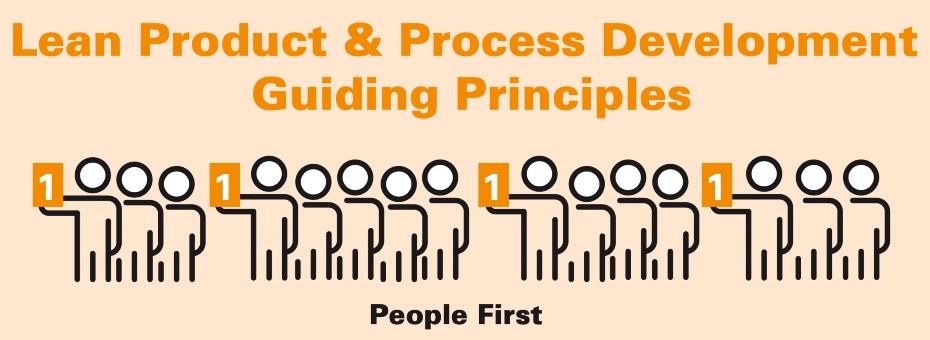
An infographic summarizes the six guiding principles of lean product and process development.

FacebookTweetLinkedInPrintComment

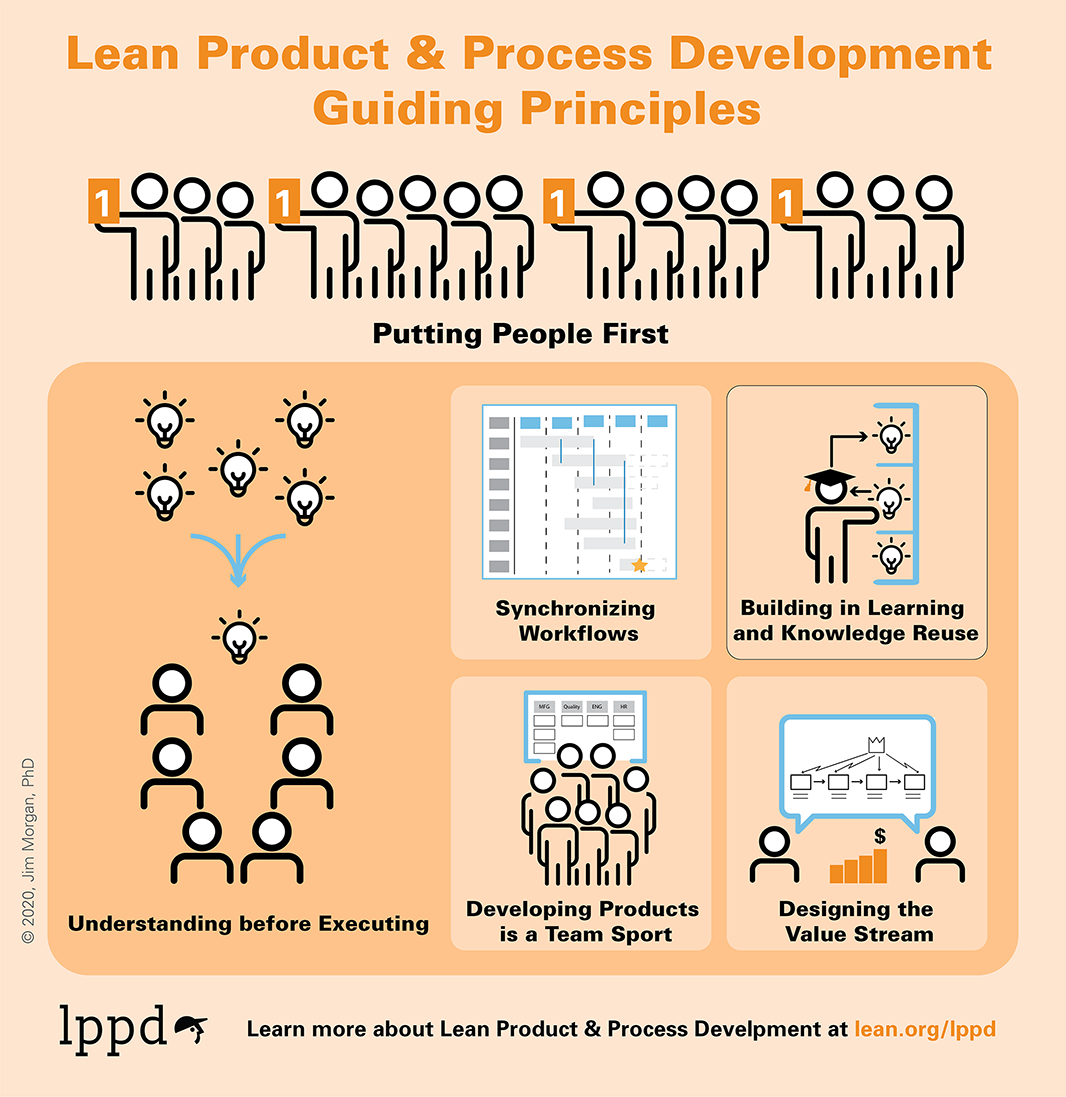
A successful lean product and process development (LPPD) system adheres to six guiding principles, asserts Jim Morgan, LEI senior advisor of LPPD and author of Designing the Future. The principles arise from the tenets of lean thinking and practice but address the unique challenges faced by new product, process, and services development teams. Here are the principles at-a-glance:
LPPD Guiding Principles

  • Putting People First: Organizing your development system and using lean practices to support people to reach their full potential and perform their best sets up your organization to develop great products and services your customers will love.
  • Understanding before Executing: Taking the time to understand your customers and their context while exploring and experimenting to develop knowledge helps you discover better solutions that meet your customers’ needs. 
  • Developing Products is a Team Sport: Leveraging a deliberate process and supporting practices to engage team members across the enterprise from initial ideas to delivery ensures that you maximize value creation.
  • Synchronizing Workflows: Organizing and managing the work concurrently to maximize the utility of incomplete yet stable data enables you to achieve flow across the enterprise and reduce time to market.
  • Building in Learning and Knowledge Reuse: Creating a development system that encourages rapid learning, reuses existing knowledge, and captures new knowledge to make it easier to use in the future helps you build a long-term competitive advantage. 
  • Designing the Value Stream: Making trade-offs and decisions throughout the development cycle through a lens of what best supports the success of the future delivery value stream will improve its operational performance.

The LPPD Guiding Principles provide a holistic framework for effective and efficient product and service development, enabling you to achieve your development goals.

FacebookTweetLinkedInPrintComment

Designing the Future Using Lean Product and Process Development

Learn how to reduce time to market, improve quality, and drive innovation in a hands-on, coach-led experience that applies Lean Product and Process Development across your value stream.

Written by:

James Morgan, PhD

About James Morgan, PhD

Jim is currently a senior advisor at the Lean Enterprise Institute (LEI) and a board member at Adrian Steel. He has a unique blend of industry leadership experience and rigorous scholarship, which he draws from to support senior leaders and help improve organizational performance in the aerospace, energy technology, heavy…

Read more about James Morgan, PhD
Comments (1)
Diane P Jahnkesays:
March 26, 2022 at 9:03 am

This 5 step process is so clear about what “people first” philosophy is. AND you get an improved process as well! Bravo!

Reply

Leave a Comment Cancel reply

Your email address will not be published. Required fields are marked *

Related

Design Brief | Reinventing Product Development: People First, Technology Second 

Product & Process Development

Design Brief | Reinventing Product Development: People First, Technology Second 

Article by James Morgan, PhD

Toyota and radical innovation: a Lean View of Woven City 

Executive Leadership

Toyota and radical innovation: a Lean View of Woven City 

Article by Marie-Pia Ignace

WLEI_20-Years-Later-How-Toyotas-Product-Developmen-Principles-Are-Still-Core-to-a-Lean-Enterprise

Product & Process Development

20 Years Later: How Toyota’s Product Development Principles Are Still Core to a Lean Enterprise

Article, Podcast by Josh Howell, James Morgan, PhD and Lex Schroeder

Related books

The Power of Process book cover

The Power of Process – A Story of Innovative Lean Process Development

by Eric Ethington and Matt Zayko

Welcome Problems, Find Success – Creating Toyota Cultures Around the World

Welcome Problems, Find Success – Creating Toyota Cultures Around the World

by Nate Furuta

Related events

Online – On-Demand, Self-Paced

Lean Fundamentals Bundle

Learn more

Online – On-Demand, Self-Paced

Lean Product and Process Development Overview 

Learn more

Explore topics

Product and Process Development graphic icon Product & Process Development
  • Privacy Policy
  • Sitemap
  • LinkedIn
  • Twitter
  • YouTube
  • Instagram
  • Facebook

©Copyright 2000-2026 Lean Enterprise Institute, Inc. All rights reserved.
Lean Enterprise Institute, the leaper image, and stick figure are registered trademarks of Lean Enterprise Institute, Inc.

This website uses cookies to improve your experience. We'll assume you're ok with this, but you can opt-out if you wish. Learn More. ACCEPT
Privacy & Cookies Policy

Privacy Overview

This website uses cookies to improve your experience while you navigate through the website. Out of these cookies, the cookies that are categorized as necessary are stored on your browser as they are essential for the working of basic functionalities of the website. We also use third-party cookies that help us analyze and understand how you use this website. These cookies will be stored in your browser only with your consent. You also have the option to opt-out of these cookies. But opting out of some of these cookies may have an effect on your browsing experience.
Necessary
Always Enabled
Necessary cookies are absolutely essential for the website to function properly. This category only includes cookies that ensures basic functionalities and security features of the website. These cookies do not store any personal information.
Non-necessary
Any cookies that may not be particularly necessary for the website to function and is used specifically to collect user personal data via analytics, ads, other embedded contents are termed as non-necessary cookies. It is mandatory to procure user consent prior to running these cookies on your website.
SAVE & ACCEPT