Since the beginning of this year, the Lean Enterprise Institute has been presenting to the lean community a weekly “feature” article or podcast. We’ve been selecting upcoming content from LEI’s three newsletters — The Design Brief, The Management Brief, and the Lean Tech & AI Journal — as well as Planet Lean, the online magazine of the Lean Global Network.
This approach naturally led to a wide range of features, often extending beyond LEI’s large manufacturing base. The posts spoke to one or more lean “cohorts,” delivering value specific to their needs as they pursue lean practices:
Leaders and Senior Executives

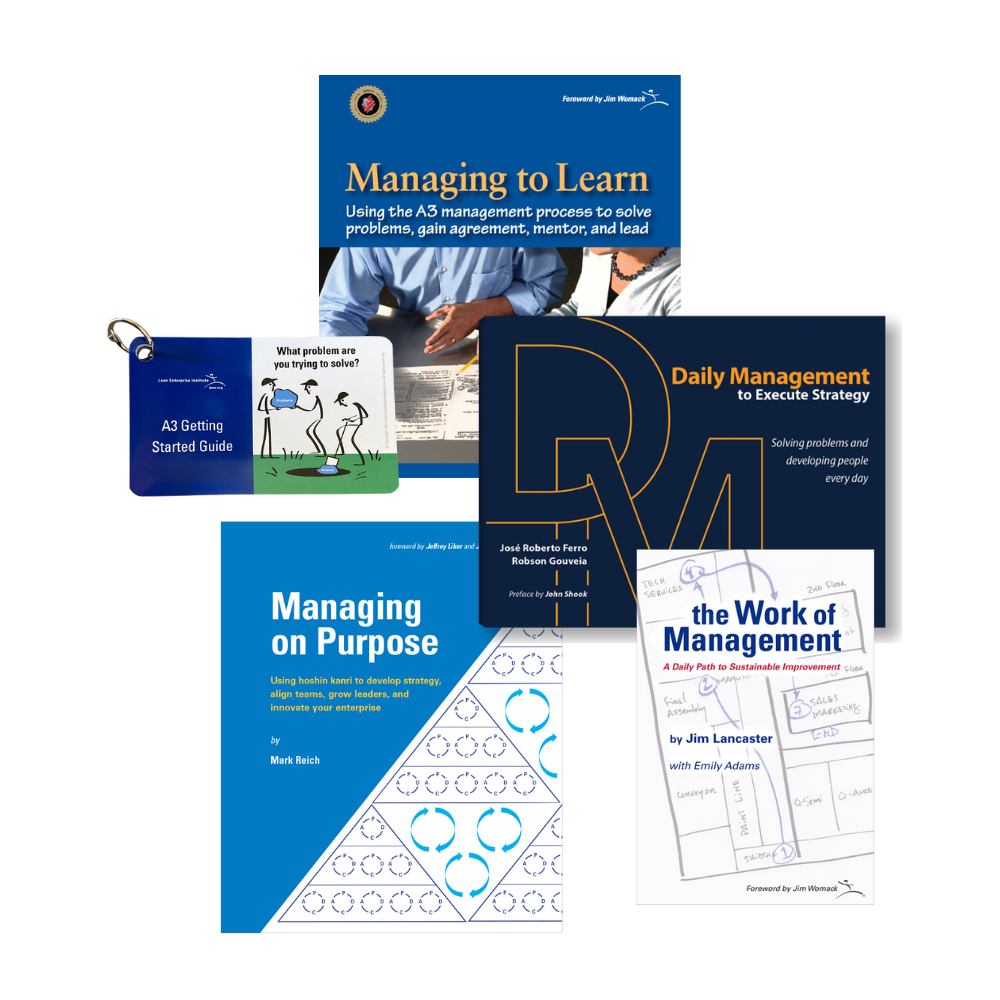
Most lean leaders seek guidance from internal or external coaches and peers to accelerate their organizations’ lean journeys and deliver greater levels of value. But coaching is not a one-way street; those coaching also learn from the experience, sometimes sharing the knowledge gained with others in the lean community. Mark Reich, Toyota veteran and LEI Chief Engineer, Strategy, explained the principles of coaching relationships — leader and consultant, manager and team member, supplier and customer — when he described What I’m Talking about When I Talk about Co-Learning. Mark, author of Managing on Purpose, which gives practical guidance on the lean approach to strategy, explained how improvement is exponential when both sides of the relationship learn.
Improvement is exponential when both sides of the relationship learn.
Mark Reich, “What I’m Talking about When I Talk about Co-Learning”
This spring I alerted executives to The Management System Your Organization Doesn’t Know It Needs. Most organizations are addressing only a fraction of their actual problems, in part because leaders aren’t aware of all the problems that exist. Their systems for rapidly detecting, surfacing, and responding to problems that could reach the customer are dramatically insufficient. What’s needed is a Toyota-style production and management system that are tightly linked: A well-developed production system rigorously establishes standards and then detects the slightest deviations from those standards. The problems or gaps the production system catches generates demand for a management system, engineered to respond to deviations (e.g., visual boards, huddles) and quickly produce meaningful countermeasures. As opposed to management working on random objectives disconnected from delivering customer value, the management system is solving customer problems in the work when they’re small and preventing gaps from widening and issues from escalating.
Technology and AI Professionals
Tyson Heaton recently warned that in the rush of companies attempting to leverage artificial intelligence, The Reengineering Is Coming just as it did when electricity reached production facilities in the 1880s and personal computers landed on desks in the 1990s. He wrote that leaders and organizations applying technology effectively andselectively to work they intimately understand get more value from their efforts because they don’t rush to automate what they really don’t comprehend; those that struggle are usually organizations where leadership has lost touch with the work and the people doing the work, believing tech is a replacement not an enhancer.
Leaders and organizations applying technology effectively and selectively to work they intimately understand get more value from their efforts.
Tyson Heaton, “The Reengineering Is Coming”
Earlier in the quarter, Art Smalley, LEI faculty member, Toyota veteran, and author, showed us what’s possible in The Strange New World of AI, sharing his personal road to improved productivity as AI helped him accomplish three projects that for years seemed too overwhelming to take on. He wrote that such capability is rapidly getting easier for anyone to access and leverage, supporting Art’s mantra of “Humans + AI > Problems.”
Product Development Engineers
Lex Schroeder and I sat down with former product development executive and LEI Senior Advisor Jim Morgan for a podcast that explored how, 20 Years Later, the product development principles in the groundbreaking book he co-authored with Jeff Liker — The Toyota Product Development System: Integrating People, Process, and Technology — are still helping engineering leaders to build teams that consistently design products customers love. Jim also discussed common hurdles companies face when putting core lean product and process development (LLPD) ideas into practice and how to begin an LLPD transformation.
Recently, Dave Leone, Senior Director, Digital & Dimensional Engineering at GE Appliances, and Jim wrote that understanding critical product attributes and delivering them with precision is absolutely necessary if you want to Design Products That Delight Your Customers and Enable Your Manufacturing. They examined dimensional control, a highly effective way to protect critical product attributes and bring product and process into alignment, which they argue is largely absent from engineering education — thus, producing engineers who don’t adequately understand how variation impacts assembly, fit, performance, and customer perception.
Healthcare Professionals
In January, LEI presented the Cleveland Clinic’s Lean Transformation, describing how for nearly 20 years the healthcare system has formally pursued improvements, helping to make it one of the leading healthcare systems in the United States. The Clinic strives to be “the best place to receive care anywhere and the best place to work,” said Dr. Lisa Yerian, Executive Vice President and Chief Clinical & Operational Improvement Officer. “We have integrated the expectation of excellence, the aspiration for excellence, in everything we do right in parallel with being the best place to work.” The Clinic’s lean transformation has moved the organization in that direction by utilizing LEI’s Lean Transformation Framework and embedding lean practices, principles, behaviors, routines, and tools into daily standard work.
In 2013, Dr. Eric Dickson took over as President and CEO of UMass Memorial Health. At the time, the large healthcare system was in financial trouble and patient and caregiver satisfaction needed improvement. LEI’s February feature described how Dr. Dickson then led the UMass Memorial Health Transformation Journey, which established a management system that defined standard processes and behaviors throughout the organization, engaged everyone in improvement activities, and developed the means for caregivers to offer tens of thousands of innovative ideas — leading to substantial improvements for patients and staff and financial stability.
Service and Retail Professionals
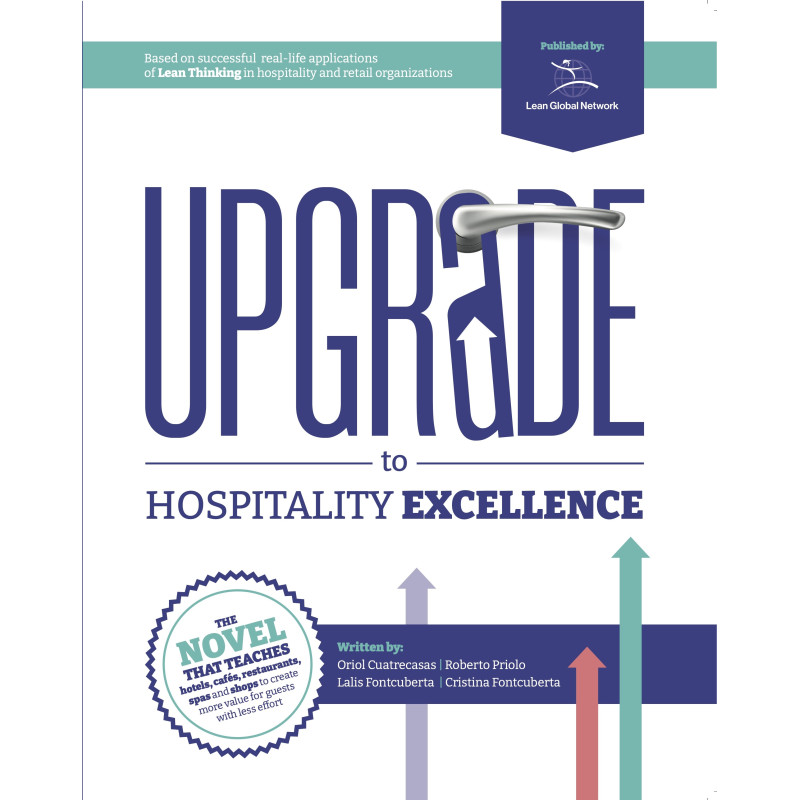
Marco Lopez, CEO Dreamplace Hotels, & Resorts in the Canary Islands, and his lean coach Oriol Cuatrecasas of the Instituto Lean Management in Spain, spoke with Mark about how effective coaching and co-learning relationships offer a “follow me and we’ll figure this out together” association. Marco and Oriol noted that they have a shared Understanding that Lean is a Journey, as Marco has been working at this for 15 years. He and others in the company originally asked, “What can we do to be more competitive,” and realized they had to do something new and that lean was the answer. Marco and Oriol discussed how lean was meant for the hospitality industry, an environment that is purely value-added and in which every customer requires a customized experience and cross-functional teams to seamlessly support the customer’s journey throughout all aspects of their stay (check-in, housekeeping, foodservice, etc.).
Lean was meant for the hospitality industry, an environment that is purely value-added and in which every customer requires a customized experience.
Marco Lopez, “Coaching and Co-Learning: Understanding that Lean is a Journey”
Scott Heydon, John Shook, and I wrote in May about Our Attempt to Improve Starbucks. Scott spearheaded the effort as Starbucks VP of Strategy, and was coached by John, Toyota veteran and former LEI CEO. At the time I was a store manager at Starbucks and eventually got pulled into the corporate Starbucks lean team. After observing a Starbucks coffee roasting facility and then multiple stores in the Portland, Oregon, area, problems were identified as well as the organization’s challenge: Apply some level of standardization to the chain with thousands of stores and growing while respecting the uniqueness of each location. Rather than corporate passing down directives on what stores should do, John and Scott introduced Starbucks leadership to a very different approach: align everyone on key problems to solve, then teach them about good work design, lean principles, and practical problem solving through a leader-led approach, and, finally, provide the knowledge and leadership support to customize routines to fit their unique clientele, mix, and layout.
Construction Professionals
Marie-Pia Ignace, co-founder of Institut Lean France, wrote about Toyota and Radical Innovation as she described the company’s Woven City project, which offers a compelling view of radical innovation in a lean organization. The aim of Woven City is to enable experimentation with new forms of mobility, services, housing, energy, and technological coordination in real-life conditions. Phase 1 of the project was completed in 2024, with the official launch taking place in 2025, and it will eventually host approximately 2,000 residents. The smart city project illustrates the Toyota way of tackling radical innovation and offers a glimpse into how lean can be applied to the design of new systems guided by a clear strategic purpose, in this case exploring mobility in a broad sense — across people, goods, information, and energy.
Early in 2025 I described the lean transformation at Turner Construction as A Long and Winding Road, which illustrated the improvement opportunities available to construction organizations and the professionals that lead them. The years-long effort required Turner leadership to apply practical strategies as they sought to navigate an unpredictable path, eventually creating a collaborative, problem-solving culture. The lean journey started with a small experiment to improve Turner’s procurement process and evolved to include more advanced and impactful lean concepts, including a daily management system, an A3 problem-solving process, and an approach to strategy known as hoshin kanri.
Newcomers to Lean

LEI faculty member Art advocated for Better Thinking Faster and wrote about the mechanisms to make better thinking reliable, transferable, and improvable. It’s not about how fast or slow you tackle problems and undertake change, argued Art, the author of Four Types of Problems, but using the right approach for the problem at hand. This article serves as a great foundation for those new to lean and problem solving, distinguishing the different levels of problem solving that exist — from almost immediate solutions to problems on the frontline to leadership taking the time to figure out how to tackle a new business objective. The cadence for each level is determined by the type of work, mechanisms in place that support and coordinate problem solving, and the type of problem. What matters is that better thinking produces faster quality of results, not speed for its own sake, but speed that comes from reducing learning friction, confusion, and rework at any level.

Many of our weekly features involved executives and lean practitioners who participated in LEI Lean Summits. To get access to some of these presentations describing real lean work and the outcomes possible, visit 2027 Lean Summit.
2027 Lean Summit
The premier leadership conference shaping the future of lean management for every business.