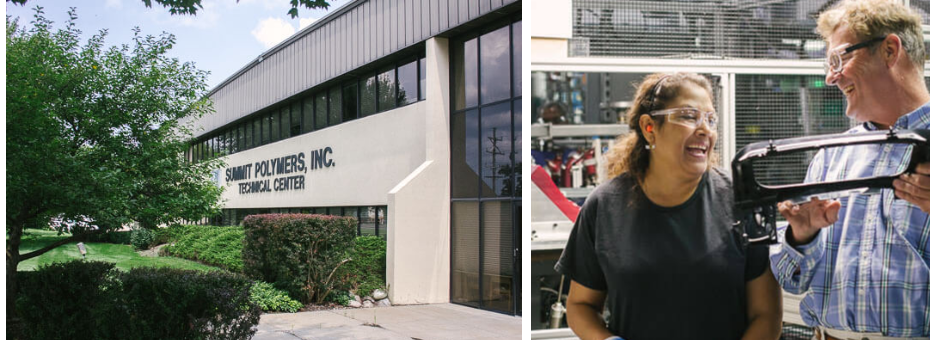
Since 2019, Summit Polymers, a privately held tier-one automotive supplier, has weathered a range of market disturbances: a six-week strike at customer General Motors in 2019, the COVID-19 pandemic and associated product shortages and logistic delays; high interest rates that weakened automotive sales; rising wages and material and freight costs, and, last but not least, chaotic and increasing tariffs. How did the company withstand them? “We leaned into lean,” said Andrea Haas, CEO.1 Summit Polymers has been able to withstand repeated disruptions because it has a lean discipline across functions and the foundation of a lean management system, enabling it to pursue ongoing improvements, standardize gains, and then raise the bar further by applying ever higher standards.
The “backbone” of the company’s operations is the Summit Lean Manufacturing System, based on the Toyota Production System. “It’s with a customer-first focus,” said Haas. “People are our most valuable resource. Kaizen. And a shop-floor focus. We really look at standardizing our operations in the pursuit of True North for zero accidents, zero defects, one-by-one production on demand and in sequence, and 100% value-added work, with the goal being world-class quality and value to our customer.”
Lean Leader
Andrea Haas began working in Summit Polymers facilities since she was 14-years-old, and her professional career has been steeped in lean since: she attended the University of Michigan, during which time she attended a senior-level lean course taught by John Shook when she was just 19-years-old. She worked at the Toyota Supplier Support Center (TSSC) and then returned to UofM for a business degree before heading back to Summit Polymers in manufacturing and engineering roles. The company, founded by Jim Haas in 1972, has maintained a more than 30-year lean relationship with the Toyota Supplier Support Center (TSSC) and is a showcase company for the organization.
Summit Polymers, headquartered in Kalamazoo, MI, produces 1 million instrument panels per year for GM. With 13 manufacturing facilities, three engineering technical facilities, and some 3,000 employees, the company touches the global automative market well beyond GM — designing, engineering, and manufacturing interior systems for Ford, Volkswagen, BMW, Nissan, Toyota, and Stellantis as well. Products include injection-molded instrument panels, consoles, door panels, and soft trim.
The company’s goals of highest quality, lowest cost, and shortest lead time are built on a foundation of stability gained through lean principles, especially jidoka, standardized work, and kaizen.
Jidoka
After increasing pay, adding attendance incentives, and relying on excessive overtime and temporary services to deal with a 15% hourly labor shortage during COVID, Summit Polymers still had challenges staffing up to meet production commitments. “At the peak of it, we had to use our technical center employees to go and take shifts on the line,” said Haas. “We also shared labor between plants. We set up busing systems to move people from plants in the same states. We worked overtime. We also said, ‘OK, we’ve got to [figure this out] — there aren’t enough people. What are we going to do?’ We started to automate.”
In lieu of readily available labor to fill the staffing gap that wasn’t getting smaller, Summit Polymers began to automate assembly, complementing the application of technologies that had already occurred in its molding and paint operations. In 2021 and 2022, the company automated 12% of its assembly processes, which was the equivalent of staffing hundreds of people. For example, it makes about 800,000 defroster grills for the F-150 truck. When the part went into production, all work was done with simple assembly machines with 18 employees. Now it’s handled by six employees who load parts for robots, which perform most of the assembly.

The integration of human and machines required standards to achieve production goals and ensure safety. “When we talk about jidoka, we talk about separating man’s work and machine work,” said Haas. “Instead of one person and one machine where the person loads it, unloads it, and then waits for the machine cycle, we changed it so that he’s loading and unloading one machine, and while that machine is running, he’s loading and unloading another.”
Jidoka, in the form of andon and poka-yoke, also has been applied to identify and stop abnormalities and make it impossible to produce a defect. Automakers have extremely low tolerance for defects — Toyota 15 ppm and GM 5ppm — and exceeding that amount makes the supplier “unsourceable,” noted Haas. Poka-yoke starts with a part’s design and building assembly fixtures in house and includes sensors on the line that prevent teams from making a defective part.
Standardization
When tariffs on China-produced goods began rising, Summit Polymers quickly reacted, building a new facility in Vietnam in 2022 to ship products to more than a dozen countries and leaving just one plant in China — all during COVID. Using standardized work for facility development, it completed construction of the Vietnam plant in just seven months and had moved all the production over the next five months. The plant subsequently has had no quality or delivery issues.
The company’s growth rate is requiring it to build about one plant on average per year. In 2023 it completed development of a $37.5 million plant in Lawrenceville, KY., expanding its leanshoring footprint to seven production facilities in the United States. The Kentucky plant houses plastic injection molding, paint applications, and assembly operations to support automotive manufacturers in Kentucky and neighboring states.2
Despite distinct locations throughout the world, including Mexico, all Summit Polymers factories look the same and have the same equipment, brands, layouts, and safety packages. This makes it possible to apply the same standardized work across all facilities for all types of work including operators on the shop floor, equipment changeovers in molding operations, and administrative and HR processes.
Problem Solving, Kaizen, and Continuous Improvement
Summit Polymers has a culture centered on practical problem solving throughout all functional areas. “When we talk about people being our most valuable resource, we’re talking about motivated and capable people driving organizational success,” said Haas. “Standardized work, problem solving, and continuous improvement define our culture. And intellectually challenging work provides growth, opportunity, and job security.”
The company challenges itself to find a better way in everything it does every day, and employees are comfortable exposing problems, attacking them, and trialing new ideas. “We seek out the root cause and fix them one by one,” said Haas. “So not to get overwhelmed, just put one foot in front of the other and keep moving forward.”
As problems are solved and progress made via kaizen — big and small — the company ensures the movement is always forward by standardizing the kaizen changes. “We’ve really worked across our company in every functional area to make a kaizen, we standardize it, make a kaizen, we standardize it, make a kaizen, and we standardize it in every department. The way we like to think about it is making mistakes is fine — it’s expected. One person makes a mistake, let them learn from it, and then we can standardize it and nobody else has to make that mistake ever again.”
Without standards, you can’t learn from your mistakes and you can’t improve.
The kaizen and continuous improvement approach exists throughout Summit Polymers locations, so wherever a solution or innovation is applied and standardized, the systems and processes are in place to share that with the whole organization. “We can take 13 global factories and harness everybody’s creativity and good ideas and their mistakes, and we can keep [improving]. Without standards, you can’t learn from your mistakes and you can’t improve — at least you can’t sustain those improvements.”
The company’s embrace of lean and its problem-solving and improvement mantra have helped it to earn numerous industry accolades, including being named GM’s supplier of the year in 2025

Summit Polymers will be sharing its lean practices as part of a Lean Leadership Learning Tour in Lexington and Louisville, KY, on Nov. 9-12, 2026. The tour also will feature tours through Toyota and GE Appliance factory, which has successfully leanshored most of its production back to the United States.
- Comments from Andrea Haas and Summit Polymers information in this report, unless otherwise cited, are from the 2025 Lean Summit presentation: “Navigating Auto Industry Uncertainty with Lean: Summit Polymers’ Approach” ↩︎
- “Summit Polymers to Invest $37.5 Million, Create 218 Quality Jobs With New Lawrenceburg Operation,” Team Kentucky, April 28, 2022. ↩︎
Lean Leadership Learning Tour
Where Billion-Dollar Decisions Meet the Shop Floor